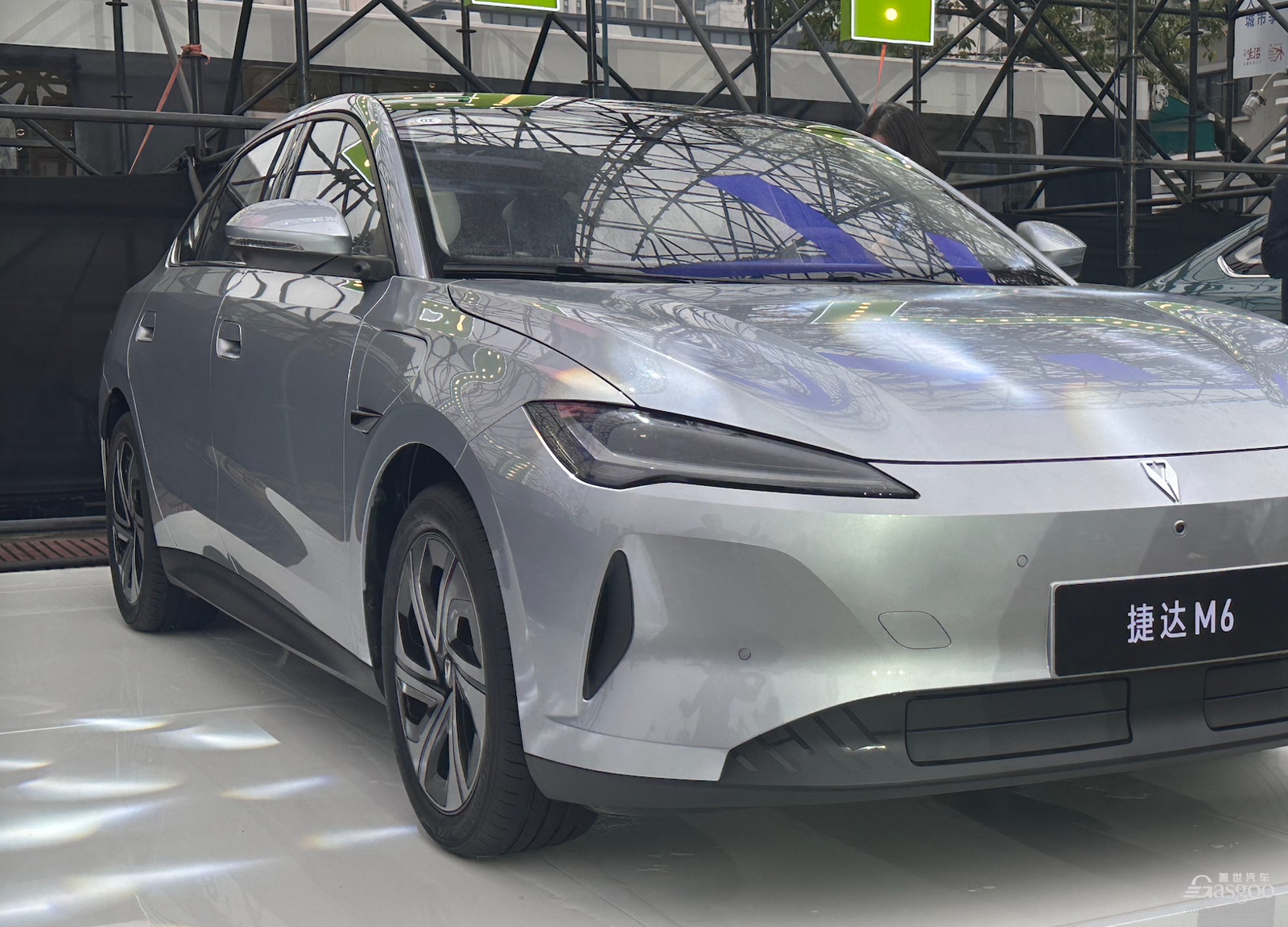
Jetta launched the M6 in Chengdu on 22 October at RMB 79,800, RMB 89,800 and RMB 99,800 for the 465 Pro, 555 Max and 555 Ultra trims, putting all three under the RMB 100,000 line. The brand’s slogan for the car is blunt about the target: under 100,000, no compromises.
The M6 carries two firsts. It is Jetta’s first locally developed battery-electric model, and the first product from FAW Volkswagen’s Jetta Technology company, set up last year with local government backing and positioned as a Chengdu-rooted company with global reach.
German validation standards, Chinese product definition
Jetta says a Chinese team led product definition and development for the M6 while the company drew on Volkswagen engineering resources, FAW capability and the local supply chain. The body uses 86 per cent high-strength steel with 31 per cent hot-stamped steel at up to 2,000 MPa, and torsional rigidity above 38,000 Nm per degree. The battery was developed to Volkswagen standards and passed more than 400 validation tests.
Packaging is competitive for the class: 2,820 mm wheelbase, a 91.3 per cent cabin-to-body ratio and 542 to 1,800 litres of boot space. Jetta ran the car through two winters and two summers of durability work and a 100,000 km internal durability test, against the 30,000 km the new national rules require.
The assisted-driving downgrade that is not a downgrade
The M6 is the first joint-venture model to put urban assisted driving into the RMB 100,000 band. A Horizon Journey 6M chip supports urban navigation assist from 0 to 120 km/h, and the car holds a Guinness World Record for parking. Inside, the infotainment runs three models, Doubao, DeepSeek and Qwen, across more than 650 voice commands.
Horizon Robotics founder Yu Kai framed the launch as a rejection of pointless competition and a push to make advanced driver assistance a standard rather than a luxury. Until now, urban assistance has mostly appeared on cars costing RMB 200,000 or more.
Why the price is the strategy
The RMB 100,000 and below electric segment is effectively closed to foreign brands. Chinese marques held all five top-selling positions in September. Joint ventures have either lacked product or priced above the band.
Jetta is attacking on both fronts at once: a starting price inside the domestic core range, plus a warranty package that includes lifetime cover on the electric drive system, lifetime cover for automatic-parking losses, free lifetime vehicle inspections, lifetime original-parts cover and lifetime compensation if a battery fire is traced to the drive system.
Cost went into safety and space rather than screens. Battery underbody impact protection is rated at eight times the national standard, and the rear crash test runs at 80 km/h against a 50 km/h requirement.
What other joint ventures will copy
The M6 is a template rather than a product: a German badge, Chinese product definition, a Chinese technology stack and a domestic price. Volkswagen already runs a similar structure on the CMP platform, where the ID. ERA 5X has just entered production.
Whether the M6 sells is a distribution question that will be answered by quarterly numbers. Whether the model works is a strategic question, and the answer is that a joint venture can now match a domestic brand on price and beat it on validation data, if it is willing to hand over the product brief.
Editor’s note: This is an adapted translation of the original Gasgoo report. It has been trimmed and restructured for readability for an international business audience. The full original (in Chinese) is at https://auto.gasgoo.com/news/202610/22I70475652C107.shtml.