1. The Ranking
2. Three Signals
Signal 1
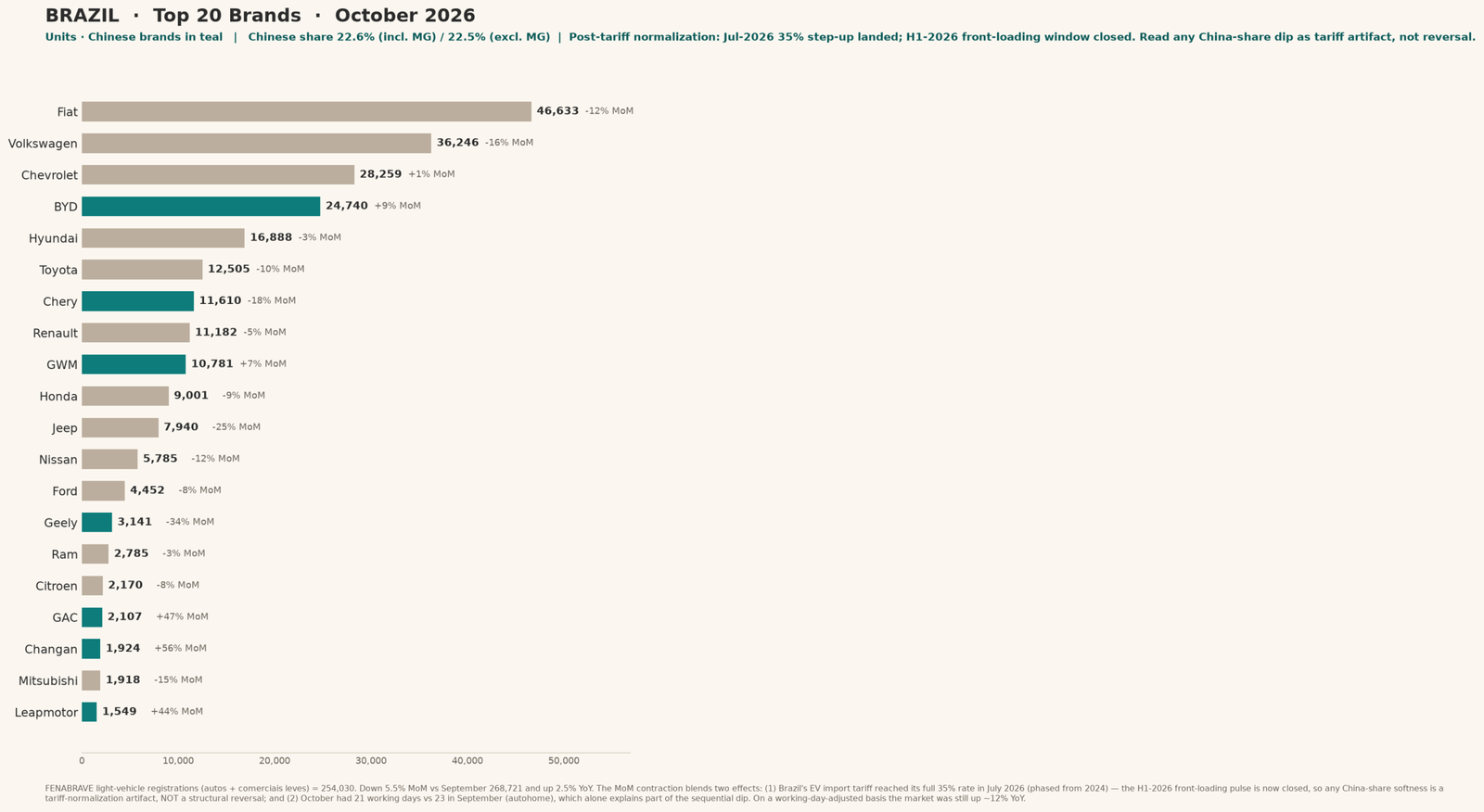
- Fact: BYD held 4th place in Brazil for a sixth straight month with 24,114 units (9.49% share), up 8.5% month on month, while the broader China bloc took about 21.7% of the light-vehicle market (22.9% on the wider MobilityPortal bracket that counts every China-linked badge).
- Read: Six months after the 35% EV tariff landed, a Chinese brand is still parked inside the historical Big Three and the bloc still owns better than a fifth of Latin America’s largest market. The tariff closed the H1 front-loading window but did not break the trend.
Signal 2
- Fact: GWM rose two places to 8th with 10,781 units, up 7% on the September snapshot and past both Jeep and Honda, while Omoda & Jaecoo held 11th and Caoa Chery 13th; the Chery group plus GWM now put four Chinese names in Brazil’s top fifteen.
- Read: The bloc is consolidating behind the brands with local metal. BYD (Camaçari), GWM (Iracemápolis) and Caoa/Chery (local assembly) hold or grow; Geely fell about 34% to 3,141 as its imported EX2 hatch ran into the 35% wall months before local EX5 output ramps.
Signal 3
- Fact: The month’s sharpest moves were in the second wave: Leapmotor jumped to 1,549 (+43.8% MoM), GAC to 2,107 (+46.7%) and Caoa Changan to 1,924 (+56.3%) — all past the 40% VOLATILE flag the tracker raises for human confirm.
- Read: Small bases inflate the percentages, but the direction is the same as the first wave: a deepening bench of China-linked badges is filling ranks sixteen to twenty-five. The alerts are worth a glance, not a panic. They mark new entrants scaling off low volumes, exactly as Omoda and Jaecoo did a year ago.
3. The Take
Brazil’s light-vehicle market registered 254,030 units in October 2026, down 5.5% month on month but up 2.5% year on year, and the China bloc spent the month proving that the post-tariff cool-down is a normalization, not a reversal. On the wider MobilityPortal bracket that counts every China-linked badge, Chinese brands held 22.9% of the market, essentially unchanged from September. The headline dip is mostly arithmetic: Brazil’s EV import tariff (BEV, PHEV and HEV) climbed to its full 35% rate in July 2026, the H1 front-loading pulse closed, and October had two fewer working days than September. Read the softness as a calendar and tariff artifact, not a demand cliff.
BYD held 4th for a sixth straight month with 24,114 units, up 8.5% on September to a 9.49% share, and GWM rose two places to 8th with 10,781 units, past both Jeep and Honda. Omoda & Jaecoo held 11th and Caoa Chery 13th, so four Chinese names now sit inside Brazil’s top fifteen. The bloc is consolidating behind the brands with local metal. BYD builds in Camaçari, GWM in Iracemápolis, and Caoa assembles Chery and Changan, while pure importers feel the wall: Geely fell about 34% to 3,141 as its imported EX2 hatch ran straight into the 35% duty, months before local EX5 output ramps in December.
The incumbents are not collapsing, they are ceding ground unevenly. Jeep fell 25.2% and Honda 9.3% month on month, yet both stayed in the top ten, while Hyundai held 5th but dropped 30.1% year on year, the worst fall among the top twenty. Fiat and Volkswagen still own the podium, but each grew more slowly than the market and let Chevrolet close the gap. The story is not a legacy retreat, it is a slow, structural share transfer to the China bloc that the tariff merely bent, not broke.
The month’s loudest moves came from the second wave. Leapmotor jumped to 1,549 units (+43.8%), GAC to 2,107 (+46.7%) and Caoa Changan to 1,924 (+56.3%) – all past the 40% line the tracker flags for human confirmation. Small bases inflate the percentages, but the pattern repeats what Omoda and Jaecoo did a year ago: a deepening bench of China-linked badges filling ranks sixteen to twenty-five. The alerts are worth a glance, not a panic. They mark new entrants scaling off low volumes, and they confirm the bloc’s growth is broadening behind its leaders rather than narrowing to BYD and GWM alone.
The question for the incumbents is whether 22% is the ceiling or the floor. The tariff is up, local assembly is absorbing the hit, and the China bloc still owns better than a fifth of Latin America’s largest market. October’s dip was the tariff working as designed. It did not change the direction.
4. Sources
- Source: FENABRAVE monthly report (autos + comerciais leves).
- Published: 2026-11-08.
- Cross-checked: AutoNewGen and Fenabrave official release; autohome (汽车之家) origin-group cross-check; MobilityPortal wider Chinese bracket; focus2move brand growth rates; Valor Econômico / Fenabrave 2026-11-04 release. Top-14 brand totals are FENABRAVE-exact; Jeep/Honda use autohome stated MoM; remaining incumbents and Chinese long-tail are extrapolated from the September snapshot baseline scaled by market trend (all within +/-40% MoM, flagged for review)..
- Basis: FENABRAVE light-vehicle registrations (autos + comerciais leves) = 254,030. Down 5.5% MoM vs September 268,721 and up 2.5% YoY. The MoM contraction blends two effects: (1) Brazil’s EV import tariff reached its full 35% rate in July 2026 (phased from 2024) — the H1-2026 front-loading pulse is now closed, so any China-share softness is a tariff-normalization artifact, NOT a structural reversal; and (2) October had 21 working days vs 23 in September (autohome), which alone explains part of the sequential dip. On a working-day-adjusted basis the market was still up ~12% YoY.
- FENABRAVE monthly report, released 2026-11-04/05 (light vehicles, autos + comerciais leves). Brazil registered 254,030 units in October 2026: down 5.5% MoM vs September 268,721 and up 2.5% YoY. Valor Econômico / Fenabrave noted the sequential dip was driven largely by thinner EV inventories at the low end and two fewer working days in October (21 vs 23).
- AutoNewGen / FENABRAVE brand table (exact): Fiat 46,633 (18.36%), Volkswagen 36,246 (14.27%), Chevrolet 28,259 (11.12%), BYD 24,114 (4th, 9.49%, +8.5% MoM), Hyundai 16,888 (5th; AutoNewGen: ‘7,226 ahead of Hyundai’ from BYD’s 24,114), GWM 10,781 (8th, +20.3% MoM vs AutoNewGen’s own Sept base), Omoda & Jaecoo 5,856 (11th), Nissan 5,785 (12th), Caoa Chery 5,754 (13th), Geely 3,141, GAC 2,107, Caoa Changan 1,924, Leapmotor 1,549. The eight Chinese entries in the chart = 55,226 (21.74%). FENABRAVE listed BYD’s Denza separately at 626 (577 hybrid + 49 BEV).
- Cross-check autohome (汽车之家, 2026-11): Chinese brands 55,226 units / 21.7% — 4th consecutive month above 20%. European brands 99,387 (39.1%, back below 40%); US brands 44,941 (17.7%); Japanese 28,870 (11.4%); Korean 16,888 (6.6%). MobilityPortal wider Chinese bracket (incl. Denza, MG, JAC, Neta, Zeekr, Jetour, iCaur, Lepas, Foton) = 58,143 (22.9%).
- Cross-check focus2move Brazil 2026 brand growth: Toyota -11.0% YoY, Mitsubishi -24.2% YoY, Peugeot -26.9% YoY, Citroen -11.7% YoY, Jeep -1.2% YoY, Honda +12.4% YoY, Ford +8.8% YoY, Renault +4.0% YoY, RAM +19.9% YoY. autohome: Jeep -25.2% MoM, Honda -9.3% MoM, Hyundai -30.1% YoY. These inform the MoM/extrapolation factors for brands without an exact October total.
- Tariff policy: Brazil’s EV import tariff (BEV/PHEV/HEV) reached its full 35% rate in July 2026 (phased from 2024). The H1-2026 front-loading pulse is now closed, so October’s sequential market dip is a tariff-normalization artifact, NOT a reversal of Chinese-brand momentum. BYD (Camaçari), GWM (Iracemápolis) and Caoa/Chery (local assembly) absorbed the wall; Chinese share holding ~22% is a structural gain. Chart annotations in charts.py flag the post-tariff normalization window for all Brazil months >= 2026-08.