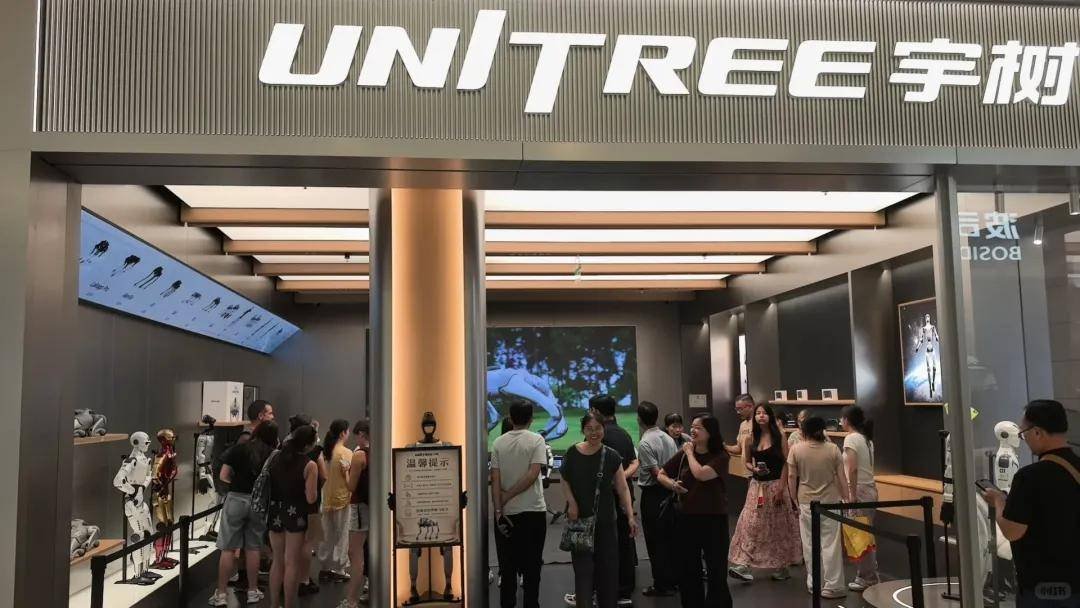
Humanoid robots are not yet mass-market consumer products, but China’s leading players are already fighting over physical retail entry points.
Two Strategies, One Goal
In late April, Unitree opened its first directly operated flagship store in Beijing’s Wangfujing Intime in88 mall. By late May, it followed up with an embodied-AI experience centre on Shanghai’s Nanjing West Road Jiuguang department store. Including an earlier co-branded location with JD Mall in Beijing’s Shuangjing district, Unitree has now planted flags in the core commercial districts of both cities.
AgiBot (Zhiyuan Robotics) took a different approach. Its first store inside a Shanghai JD Mall is not a product showcase but a “deployment-state” demonstration zone. The space features guided tours, live demos and scenario-based setups spanning retail complex operations — logistics, cleaning, customer service. It functions more as a brand experience centre and B2B consultation hub than a consumer electronics shop.
Who Is Actually Buying?
The honest answer: almost nobody is buying these for home use yet. When Unitree’s Shanghai store opened on day one, orders did come in — but buyers cited reasons like “adding tech atmosphere to our company showroom.” Family users asked questions but mostly left without purchasing. AgiBot staff have acknowledged that individual household purchases are vanishingly rare: “buying one for home feels wasteful, and it needs maintenance — it’s not a pure toy.”
The real buyer profile today is B2B: corporate showrooms, commercial performances, research labs, tourist attractions, educational institutions and secondary developers. AgiBot’s sales team reports that recent purchasers include Shanghai universities, BYD, tourism operators and companies from France and Germany — for teaching, exhibition, industrial tasks and resale after customisation.
The Economics of Robot Retail
Unitree’s financials tell a more nuanced story than the storefront hype would suggest. The company’s STAR Market IPO application was approved in just 73 days. Revenue reached $1.708 billion yuan in 2025, up 335% year-on-year. But Q1 2026 non-GAAP net profit fell 52.55% to $40.25 million yuan, with net margin compressing from roughly 35% to around 9.5%. The message is clear: when a robotics company moves from technology demos to market education, channel building and offline delivery, those costs hit the P&L hard.
Across the industry, stores are getting heavier, not lighter. Wuhan now boasts a “7S” robot dealership (sales, parts, service, feedback, solutions, display, training). Changsha has a “9S” outlet adding leasing, custom development, product launches, incubation, science-popularisation and talent training. The proliferating “S” labels borrow from automotive 4S-store terminology — except that cars have clear use cases and robots do not.
The Real Question
EVs succeeded in shopping malls because consumers knew exactly why they wanted one: commuting, family transport, business travel. Robots face a different hurdle. Families get excited, take photos, let children try the demo — then hit the same wall: what would I actually do with this at home? Companionship, education, entertainment, security, parcel collection — every use case sounds plausible, but none is yet compelling enough to trigger mass adoption.
The current retail push is less a victory lap and more an industry playing catch-up on basics: no channels existed, so companies built them; no service network existed, so they embedded it in stores; no trust existed, so they put robots within arm’s reach. The race is not about who opens the most locations. It is about who can convert a showroom into a self-sustaining commercial network of orders, service revenue and real-world deployment data.
Read the original report (Sohu IT)
*Translated and adapted from Sohu IT (it.sohu.com).*