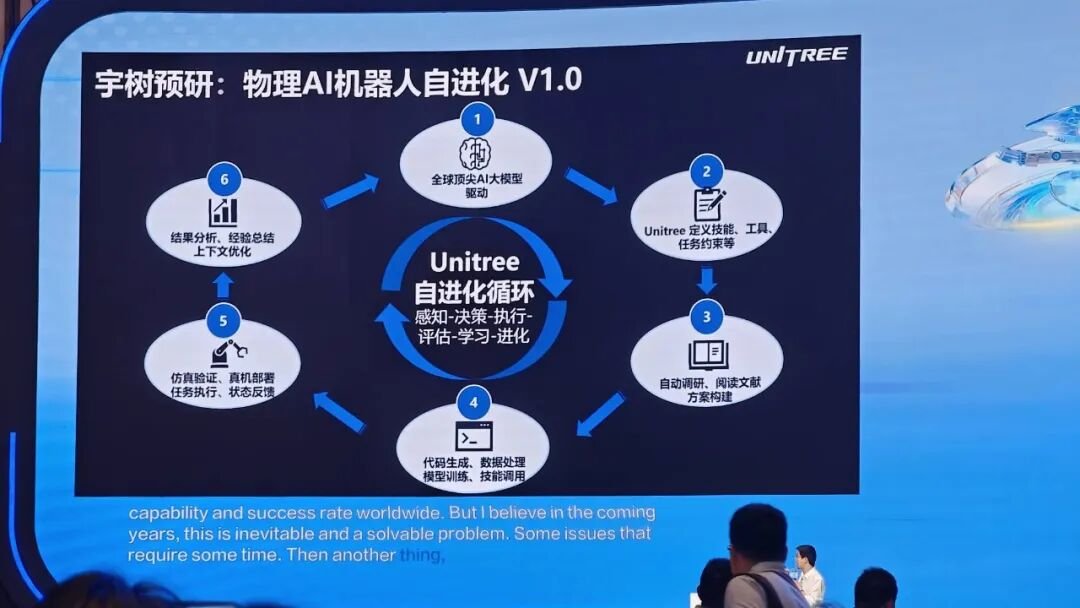
BEIJING, 19 August 2026. Unitree listed on the STAR Market on 19 August. At the post-listing banquet, founder Wang Xingxing first floated “physical-AI robot self-evolution”, using foundation models to close a loop of paper search, code generation, simulation training, real-machine testing and evaluation feedback, shifting robot development from heavy human reliance toward continuous self-iteration. The next day, on the WRC 2026 main forum, he returned to the same theme, but spent less time on how fast or high a robot jumps and more on the less flashy question that decides the industry: when will robots truly enter factories and homes.

To Wang, the key is no longer whether a body can perform one action, but whether it can still perform after the room, object or task changes, that is, generalisation. On that basis he gave a quantitative tipping point for the industry’s big breakout: two 80 per cent milestones, meaning in 80 per cent of unfamiliar scenarios, via voice or text commands, a robot can complete about 80 per cent of tasks. The path to get there is physical-AI self-evolution, handing the research-simulation-test loop to AI rather than having engineers fine-tune the “last centimetre”.
Wang reviewed the past year: the Wu BOT performance on the Lunar New Year Gala fusing kung-fu culture with AI training, and a 50-robot show at the Temple of Heaven. Since 2024 Unitree has worked with car factories on production-line applications and deploys robots in its own factory. The reason robots are not yet mass-adopted, he said plainly, is that efficiency and versatility are still insufficient: a robot can do simple assembly but slower than a person, and every new task needs retraining.
In April the company hit a peak speed of about 10 m/s (36 km/h) on a modified first-generation H1, a humanoid running-speed world record. On data, Wang stressed that real human and internet data remain the main pre-training corpus plus a slice of real-machine data. In May Unitree previewed what it calls the world’s first mass-production manned mecha, roughly 3 metres tall and about 500 kg loaded, which can transform into a four-legged mode for stability in rough terrain.
The company also demonstrated multimodal, end-to-end voice-driven action generation with a few seconds of latency, and a conference-room tidying task where one model switches across seven or eight tasks with interference resistance, though end-to-end motion is still slow. A lighter wheel-leg quadruped, the As2-W, weighs about 25 kg with strong payload and range. A “Superman” humanoid preview reached 12.66 m/s, beyond the fastest human sprinter on record, and a jump height above the human record.

Wang revisited the VLA and world-model debate, noting Unitree restarted video-generation world-model work last year after an early pause. The real bottleneck, he argued, is generalisation: in one fixed scene a model can hit near-100 per cent success, but change the object or environment and success collapses. The failure usually happens in the last few centimetres or millimetres, where small errors cannot be corrected. Language models live in clean vector space; robots incur physical error on every input and output.
His proposed fix is the physical-AI self-evolution loop. A coding agent writes robot control code, runs it in simulation, then on real robots, with AI and human evaluation feeding back to the coding agent, a positive loop that compounds as base models improve, uses more diverse data and drives more real deployments. Wang argued this is one of the most worthwhile pursuits of the coming years, and that the evolution speed of robots will likely outpace his own estimates.

Editor’s note: This is an adapted translation of the original Leiphone report. It has been trimmed and restructured for readability for an international business audience.