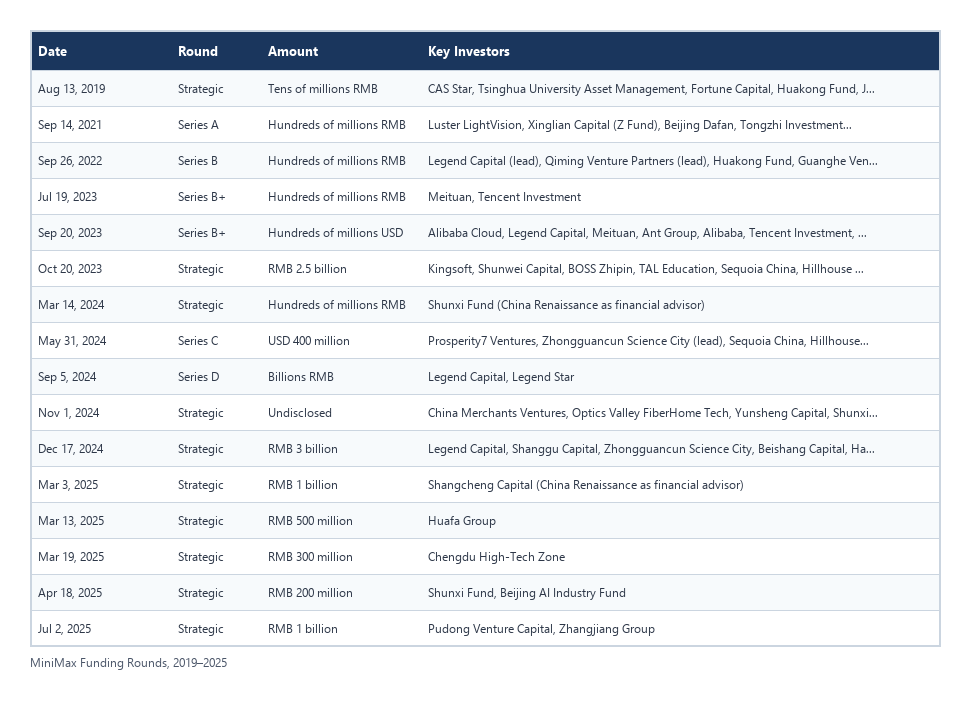
| Date | Round | Amount | Key Investors |
|---|---|---|---|
| Aug 13, 2019 | Strategic | Tens of millions RMB | CAS Star, Tsinghua University Asset Management, Fortune Capital, Huakong Fund, Jiangmen VC, Turing Ventures |
| Sep 14, 2021 | Series A | Hundreds of millions RMB | Luster LightVision, Xinglian Capital (Z Fund), Beijing Dafan, Tongzhi Investment, Xingtang Tongzhi, Rongpin Investment |
| Sep 26, 2022 | Series B | Hundreds of millions RMB | Legend Capital (lead), Qiming Venture Partners (lead), Huakong Fund, Guanghe Ventures, Today Capital |
| Jul 19, 2023 | Series B+ | Hundreds of millions RMB | Meituan, Tencent Investment |
| Sep 20, 2023 | Series B+ | Hundreds of millions USD | Alibaba Cloud, Legend Capital, Meituan, Ant Group, Alibaba, Tencent Investment, Xiaomi |
| Oct 20, 2023 | Strategic | RMB 2.5 billion | Kingsoft, Shunwei Capital, BOSS Zhipin, TAL Education, Sequoia China, Hillhouse Capital, NSSF Zhongguancun Innovation Fund |
| Mar 14, 2024 | Strategic | Hundreds of millions RMB | Shunxi Fund (China Renaissance as financial advisor) |
| May 31, 2024 | Series C | USD 400 million | Prosperity7 Ventures, Zhongguancun Science City (lead), Sequoia China, Hillhouse Capital, Legend Capital |
| Sep 5, 2024 | Series D | Billions RMB | Legend Capital, Legend Star |
| Nov 1, 2024 | Strategic | Undisclosed | China Merchants Ventures, Optics Valley FiberHome Tech, Yunsheng Capital, Shunxi Fund, Hillhouse Capital, Sequoia China |
| Dec 17, 2024 | Strategic | RMB 3 billion | Legend Capital, Shanggu Capital, Zhongguancun Science City, Beishang Capital, Hangzhou City Investment |
| Mar 3, 2025 | Strategic | RMB 1 billion | Shangcheng Capital (China Renaissance as financial advisor) |
| Mar 13, 2025 | Strategic | RMB 500 million | Huafa Group |
| Mar 19, 2025 | Strategic | RMB 300 million | Chengdu High-Tech Zone |
| Apr 18, 2025 | Strategic | RMB 200 million | Shunxi Fund, Beijing AI Industry Fund |
| Jul 2, 2025 | Strategic | RMB 1 billion | Pudong Venture Capital, Zhangjiang Group |
In the AI era, no one can know who wins in the end — a line that fits Zhipu and MiniMax perfectly.
When both listed in Hong Kong this January, Zhipu briefly broke below its issue price on day one, while MiniMax doubled, reaching nearly twice Zhipu’s market value. The market clearly preferred the company with a global consumer story — 300 million users worldwide, over 70% of revenue from overseas — to one selling private deployments to government and enterprise. Six months later, the picture has quietly reversed.
On July 8-9, both faced their first post-IPO lockup expiry. Zhipu closed up 13.35%, its value steady around HK$813.7 billion, later briefly topping HK$1.3 trillion — the first Chinese foundation-model firm to touch a trillion. MiniMax fell 17.98% on its expiry day, dropping below HK$100 billion; a day later it fell another 9.68%, even after founder Yan Junjie announced pay cuts, share grants and fresh funding.
Zhipu: high valuation, high anxiety
Zhipu’s path was set at birth. Its core team came from Tsinghua’s Knowledge Engineering Group, and it anchored early on the domestic government-and-enterprise market — text, code, long context, data compliance. Before listing it had raised over 8.3 billion yuan across eight rounds at a 24.38 billion yuan valuation, backed by Alibaba, Tencent, Meituan, Xiaomi, plus top VCs and state capital.
Commercially it is a textbook B2B play: its GLM models sold via a MaaS platform for API calls, private deployment and industry solutions. By March 2026 its API annual recurring revenue hit 1.7 billion yuan, up roughly 60x year on year, with over 242,000 paying developers. After GLM-5 launched it raised some prices 30-100%, yet call volume still grew over 400% — evidence of real pricing power. Revenue rose from 57.4 million yuan in 2022 to 312 million in 2024, then 191 million in H1 2025, up 325% year on year.
But anxiety came with the highs. Zhipu ranks first among China’s independent general-model developers by 2024 revenue — yet holds just 6.6% market share in a highly fragmented field. The deeper worry: can B2B sustain a trillion-HKD valuation? In 2025, localised deployment was 73.7% of revenue — high-touch, project-based, labour-heavy work that resists exponential scaling. On July 11, founder Tang Jie’s internal letter “The Great Wave Has Come” bared the tension: “Others ring the bell; we reset to zero. If the destination is AGI, short-term gains are just scenery. Not reaching the summit is failure.” A trillion valuation prices in extreme AGI expectations — so any doubt about Zhipu’s lead reprices it instantly. The day after Kimi K3 launched, Zhipu’s stock dived 28.49%, wiping out over HK$200 billion; on July 20 it fell another 19.56%.
MiniMax: betting on the consumer future
MiniMax turned instead to consumers and globalisation: Hailuo AI targeting AI video, Talkie/Xingye for AI companionship, plus voice models — monetised through a traffic-subscription-API model. It has roughly 300 million users across 200-plus countries, with over 70% of revenue from overseas, the only Chinese model firm scaling on overseas consumer subscriptions. Before IPO, nearly 30 institutions invested about $1.5 billion across seven rounds. Revenue jumped from $3.46 million in 2023 to $30.52 million in 2024 (up 782%) and $79 million in 2025.
But revenue growth did not translate to market value. After a 109% debut pop and a HK$410 billion peak in March, MiniMax lost over 80% of its value after lockup, falling below HK$70 billion. Its flagship M3 landed only ninth on Artificial Analysis’s index; JPMorgan cut it from overweight to neutral, noting no new domestic SOTA model since M2. Worse, M3 switched billing from subscription to per-token, and users burned through quotas far faster than expected, forcing a permanent 50% price cut a week later. Third-party data showed Talkie and Xingye monthly actives falling sharply in Q4 2025, while Hailuo was overtaken on video leaderboards by models from Alibaba, ByteDance and Kuaishou.
For a consumer-first firm this is nearly fatal: consumer users are price-sensitive and low-retention, easy to grow but hard to monetise, with near-zero switching cost. MiniMax also faces compliance risk — Disney and Universal have filed copyright suits over Hailuo-generated content. It has proven it can build world-class AI products; what it now faces is a slower, harder technical narrative.
Groping through uncertainty
Both must answer the same question: how do you close a real commercial loop in large models? Zhipu’s answer is B2B government-and-enterprise, building a moat from pricing power and stickiness. MiniMax bet on consumer globalisation, trading product scale for imagination — but a moat that is shallower than it looks once model capability is matched.
The paths may eventually converge. Zhipu, secure in B2B, will sooner or later need consumers to reach broader scenarios and data; MiniMax, stalled in consumer, needs B2B for certainty. The crossover has begun — ByteDance’s Doubao pushing from consumer to enterprise, DeepSeek blending both. Whoever finds the intersection first is likelier to build a durable loop. But the deeper question remains: in a field where models iterate faster than computer vision ever did, can any commercial loop last? Today’s moat can be breached by tomorrow’s model. That is Zhipu and MiniMax’s shared predicament — each found a road, but whether it leads to a large and stable enough business, in a paradigm that keeps shifting, no player can yet say for sure. Even Moonshot, IPO-bound after dazzling the world with K3, cannot know how long the dazzle lasts.
Source: Sohu IT. Translated and adapted from Sohu IT (it.sohu.com).