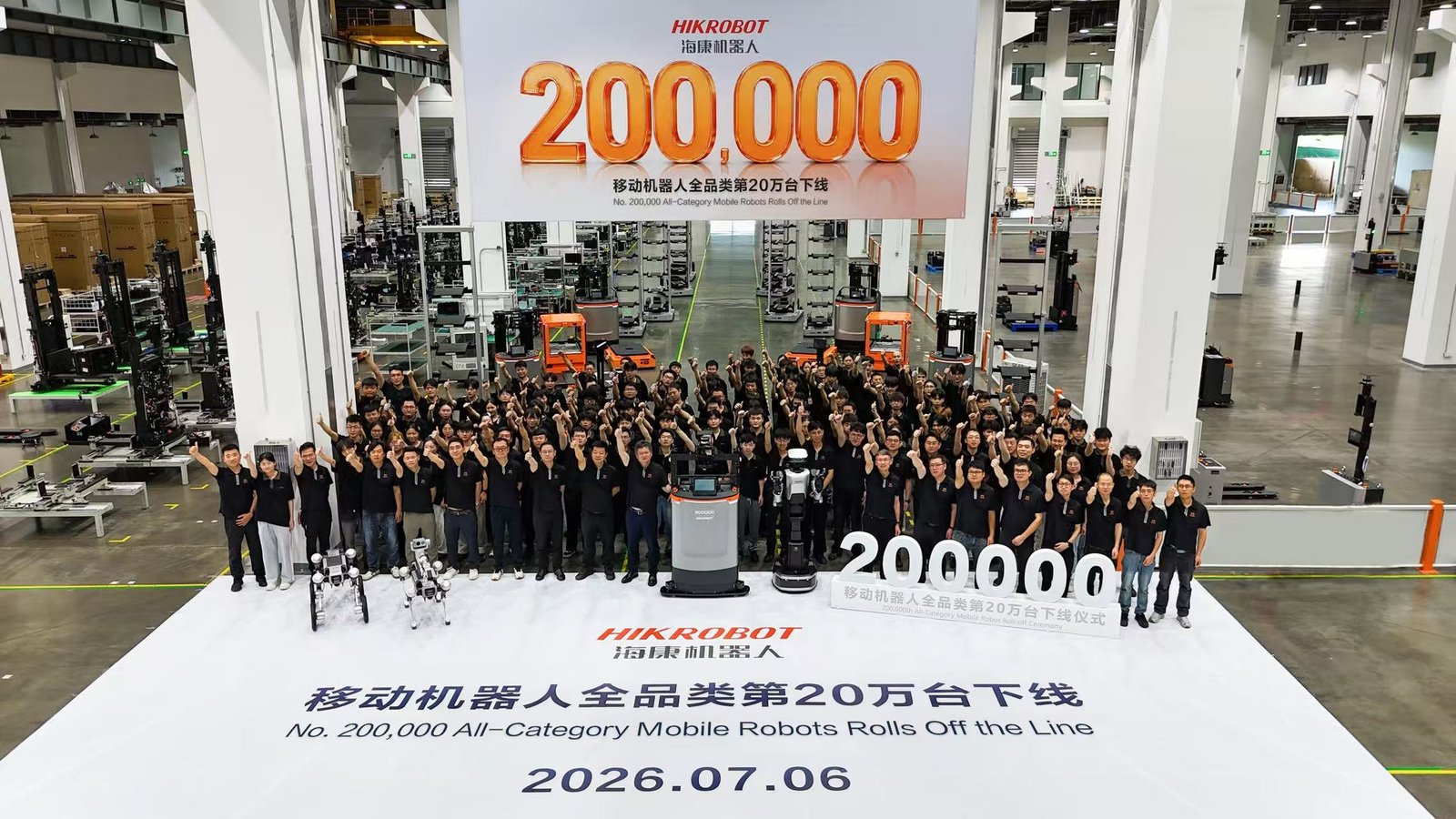
On 6 July 2026, as a forklift mobile robot came off the line, Hikrobot said its cumulative mobile-robot output had crossed 200,000 units. It reached the previous 100,000 milestone in May 2024, meaning the second hundred thousand took just two years. The Mobile Robot Industry Alliance ranked the company first in global mobile-robot share for 2025.
From ‘can move’ to ‘can be scheduled’
Scale is the result of long accumulation in technology, product, scenario and standards, not just capacity. Hikrobot’s path runs from early latent, forklift and omnidirectional models to a safety controller with the world’s first SIL3 certificate, China’s first full-directive CE for omnidirectional forklifts, and a fourth-generation ‘smart base’ platform. Its software architecture went through four iterations, from warehouse scheduling to mixed scheduling with low-code secondary development, and core links from electric control to perception are fully self-developed.
On standards, Hikrobot has written or revised more than 37 mobile-robot standards. In June 2026 its national standard for logistics-robot information systems won Zhejiang’s major standards-innovation award, the first systematic global spec for logistics-robot information and a fill for a blank in the field.
An ecosystem, not just hardware
By April 2026 Hikrobot had served over 20,000 customers across more than 1,000 scenarios, covering automotive, 3C electronics, photovoltaics, lithium batteries, retail, medicine and tobacco. At a Toyota joint venture it deployed over 2,000 mobile robots in a single plant; at Changan’s smart factory, 687 robots lifted efficiency and cut line cost by 20 per cent each. In its 200-acre Tonglu campus, mobile, vision and joint robots now coordinate ‘eye, foot and hand’ in production, supporting annual capacity of 75,000 mobile robots. The lowering of deployment cost is turning robotic manufacturing from a showcase into a default.
Read the original report (Leiphone)
Translated and adapted from Leiphone (leiphone.com).