At the end of 2026, embodied intelligence may finally have found its breakthrough. The industry has long been held back by brains that cannot handle complex environments and hands that are inflexible and expensive to train. Two technical advances have started to loosen both ends.
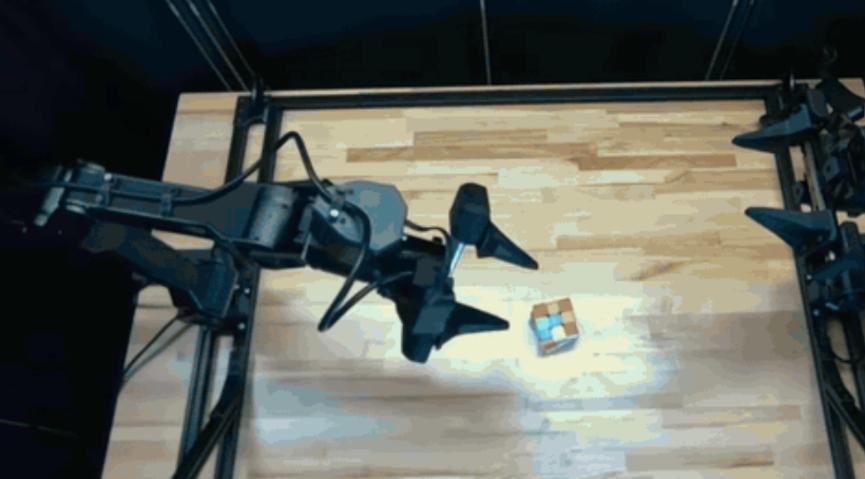
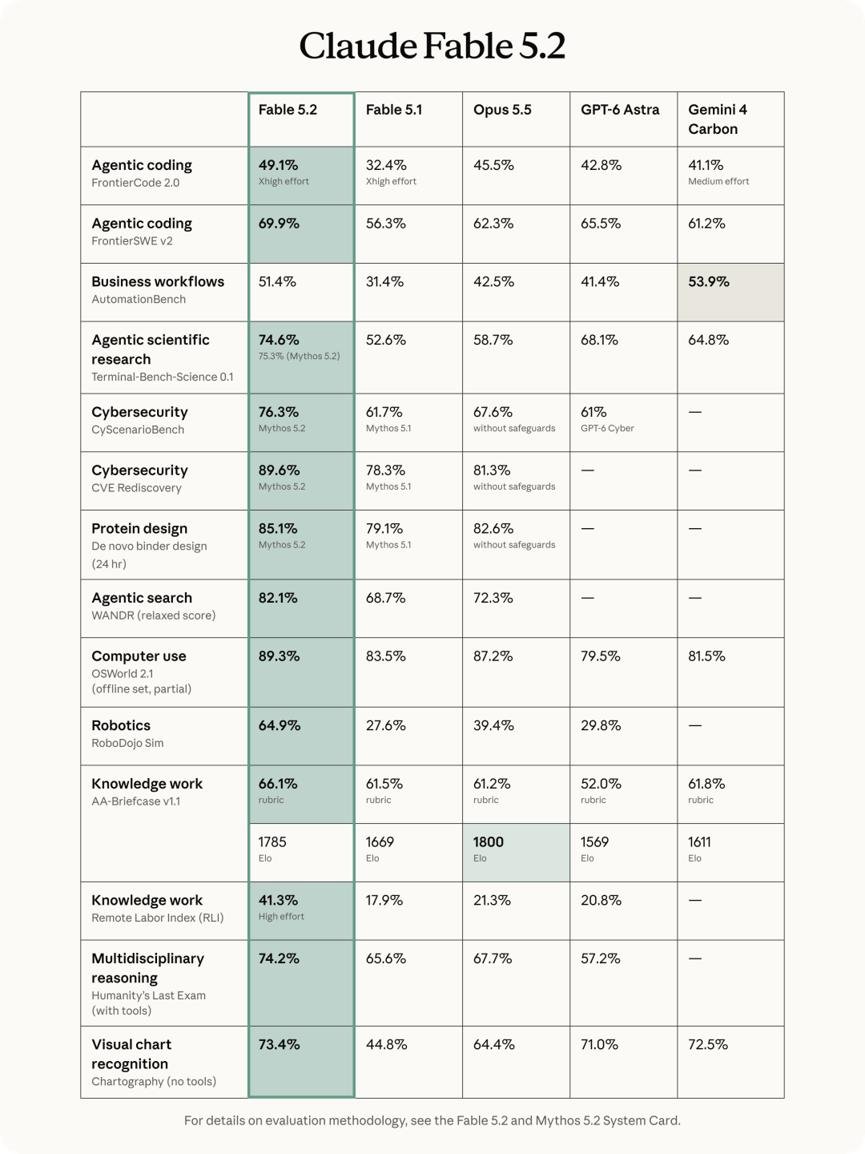
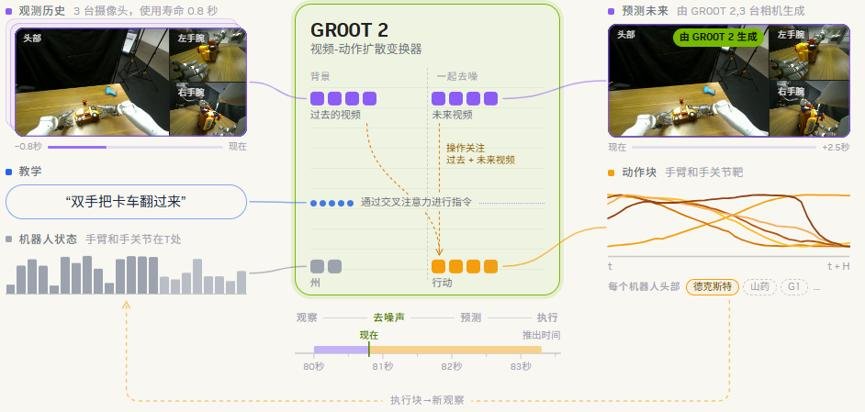
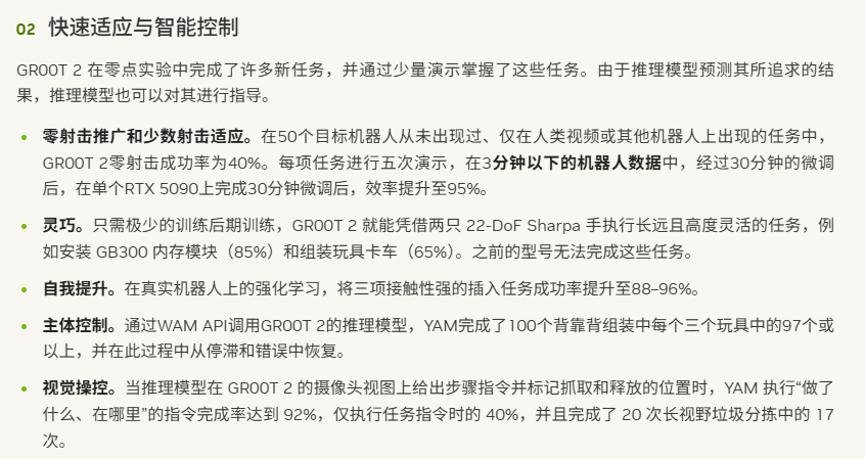
Anthropic’s general model Fable 5.2, built mainly for coding and reasoning, lifted the task success rate on the dual-arm robot simulation benchmark RoboDojo from 27.6 per cent for its predecessor to 64.9 per cent. In demonstration video, without specific training, it controlled a robotic arm to unscrew a bottle cap and solve a Rubik’s cube. Nvidia’s GR00T 2 robot foundation model uses a world-action approach that needs no mass data feed. After five human demonstrations, its average task success rate reached 95 per cent.
The brain has broken a boundary and the hand has fallen in price. But are the two on the same track?
Two scores, two sets of conditions
Fable 5.2 genuinely raises the ceiling for the brain. In simulation it reaches 64.9 per cent through strong high-level spatial reasoning. It understands physical common sense: to open a cap, grasp first, turn anticlockwise, and estimate how much force to use. It closes a loop from vision to reasoning, far more flexible than dedicated policies that memorise one action and fail in a new scene.
In the real world that intelligence weakens. In third-party hardware tests, an LLM-guided arm playing checkers saw pieces slip or shift 14 times. The problem is frequency. To catch an object at the instant it starts to slip, low-level force control must run at 20 to 100 Hz, correcting every 10 to 50 milliseconds. Fable 5.2’s planning loop runs at about 1 to 2 Hz. The model issues one or two grip commands a second while the fingers need dozens of micro-adjustments. When the piece slips, there is no time to send a tighter grip.
A general issues orders once a second while soldiers meet bullets every ten milliseconds. However good the plan, the hand cannot execute it. And 64.9 per cent was measured in a perfect simulation with no light interference or floor vibration. The official release claims 18 real-robot tasks but gives no corresponding scores.
GR00T 2 does lower the barrier for the hand. Five demonstrations for 95 per cent average success means a behaviour that once needed months of data collection can be taught in minutes. That is a real cut in training and adaptation cost. The score needs its conditions read. Nvidia’s technical white paper says the 50 Dexter manipulation tasks were selected at test-set construction stage from tasks the model could already reach at least 80 per cent on after five demonstrations, and states that the 95 per cent is affected by that selection method.
In other words, the 95 per cent comes from a pre-screened exam. Only 37 of the 50 tasks succeeded on every trial. The other 13 still failed in repeated testing, and the 37 out of 50 stability figure is absent from the official publicity. Training becomes cheaper on selected tasks, but reliability on an unseen line remains a blind box. Nobody has filled the millisecond reflex gap at the boundary between model and actuator.
Nvidia appears aware of the disconnect. GR00T 2 is kept at the execution layer, called by a higher reasoning model through a world-action model API. The upper layer sets the task, arranges skills and monitors progress; GR00T 2 turns intent into grasping and assembly. With a reasoning model attached, a YAM arm reached 97 per cent in a task combining three toys in sequence. That gives the two sides a communication protocol, not a built bridge. If the upper layer sends a command and the lower layer fails, or an arm freezes mid-air, the engineering answers on latency control and failure detection are in neither the Fable paper nor the GR00T demonstration data.
The line account that does not add up
On the production line, the first problem is not technical. The seller and the buyer are not on the same channel. However good the model’s report card, a factory owner first asks how long it takes to recover the cost of equipment worth hundreds of thousands.
Morgan Stanley’s November survey found that 82 per cent of enterprises demand payback within three years, with an average acceptable period of 26 months. Only 18 per cent of adopters were satisfied with current robot performance, down five points from a year earlier. Deployment expectations slid by about a year.
The hidden costs matter more than the machine. The China Academy of Information and Communications Technology report on embodied intelligence for 2026 says the robot body is only 40 to 60 per cent of total lifecycle cost. The rest goes to scene modification, system integration, data collection, model training, operations staff and downtime.
Fable 5.2 and GR00T 2 cut early research and training cost. They do not touch the expensive later running cost, whose main cause is the gap between thinking and doing.
NEURA’s 4NE-1 humanoid fell over at Computex after a brief communication fault triggered a safety shutdown. On a stand that is a controlled fall. On a line it is unplanned downtime. Nissan deployed OTTO mobile robots at its Smyrna plant in Tennessee. The hardware was fine, but the software interface did not align with Nissan’s material flow, and two robots sent to the same position created a traffic jam.
Such shutdowns are changing the customer’s test. An executive at AgiBot’s Genie business said a traditional factory allows 4 to 5 per cent downtime a day and simply restarts, while embodied intelligence is now judged on continuous working time, with a single fault requiring at least a month of survival to pass. The customer cares about the stability of the line.
Morgan Stanley puts it plainly: frontier models can already generate robot actions zero-shot, but cost, task success rate and latency need work. Until there is quantifiable productivity evidence, enterprises will not place large repeat orders. Chasing model scores no longer matches the immediate need.
Building a cushion between thinking and doing
Vendors are shifting. AgiBot’s answer targets the time gap directly with an asynchronous dual system. A slow system handles deep planning, updating the broad direction once or twice a second. A fast system runs dozens of times a second. It receives the slow system’s intent and, between commands, makes local corrections from its own real-time observations. The slow system points the direction while the fast system holds the motion steady, and neither waits for the other.
Figure AI treats error as a normal condition. When a battery runs low the robot swaps itself out. If hardware or software faults appear it leaves the work zone and another unit takes over, so the line does not stop. Under that model, Figure handled nearly 250,000 parcels in 200 hours of continuous operation.
Keeping robots at work as stable productivity is becoming the industry’s direction. The new competition is no longer only about scoring higher on benchmarks. It is about filling the seams, the milliseconds, the failure modes and the cost of a line that stops.
Editor’s note: This is an adapted translation of the original 36Kr report. It has been trimmed and restructured for readability for an international business audience. The full original (in Chinese) is at https://36kr.com/p/4077960501008008.