For a decade, progress in AI has been measured with one ruler: how much a machine can do on its own. By that measure the scorecard is impressive. Agents write and review code, draft documents and work at a computer for hours at a stretch. Meta, xAI and OpenAI have rolled out personal agents that sit in the background and watch long-term goals. Embodied AI is the other hot field, giving robots bodies, perception and objectives. Personal agents and embodied intelligence are the two terms on everyone’s lips.
A simpler question is rarely asked. As AI grows stronger, does the person using it grow stronger?
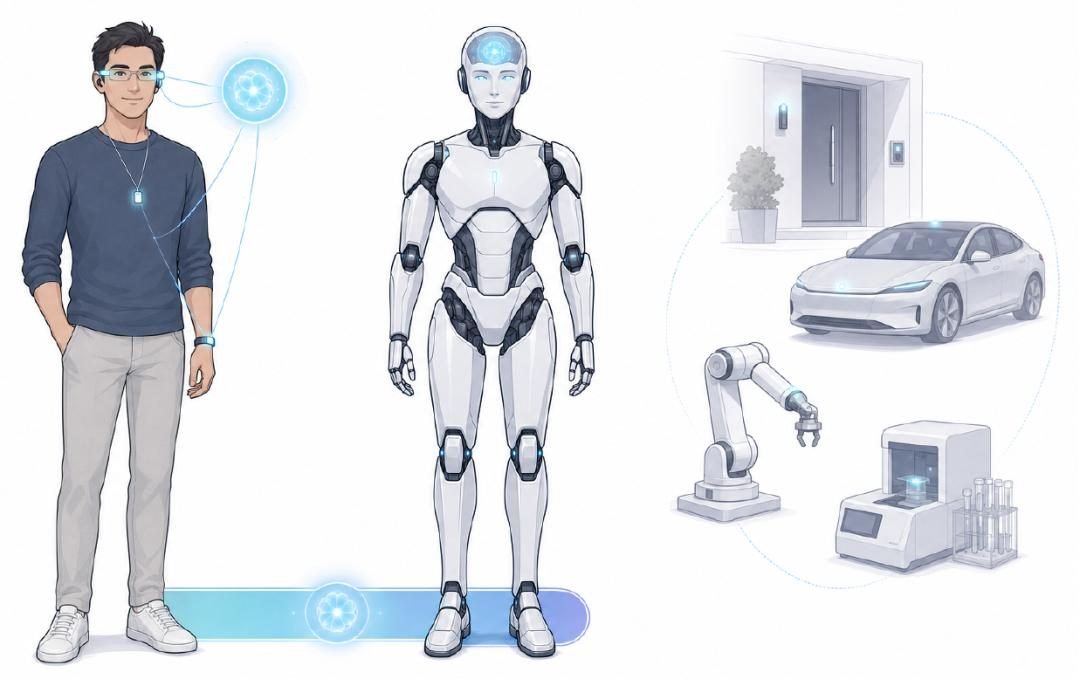
An idea at breakfast is gone by the time you reach the desk. A colleague asks for a figure from three years ago and it will not come back. Late at night, a familiar decision returns and you cannot recall how you resolved it last time. AI is taking on more tasks, while the human cognitive frontier has barely moved.
The half of physical AI nobody named
Hao Fei, a senior researcher in computer science at the University of Oxford, posted a 59-page perspective paper on arXiv arguing that physical AI has a second intelligent entity as important as the embodied robot: the human augmented by AI.
Embodied AI gives machines a body, and it is the half of physical AI most discussed. Fei’s paper is about the forgotten half, where AI leaves the computer and enters a person’s life, seeing what they see and hearing what they hear, so the person becomes cognitively stronger.
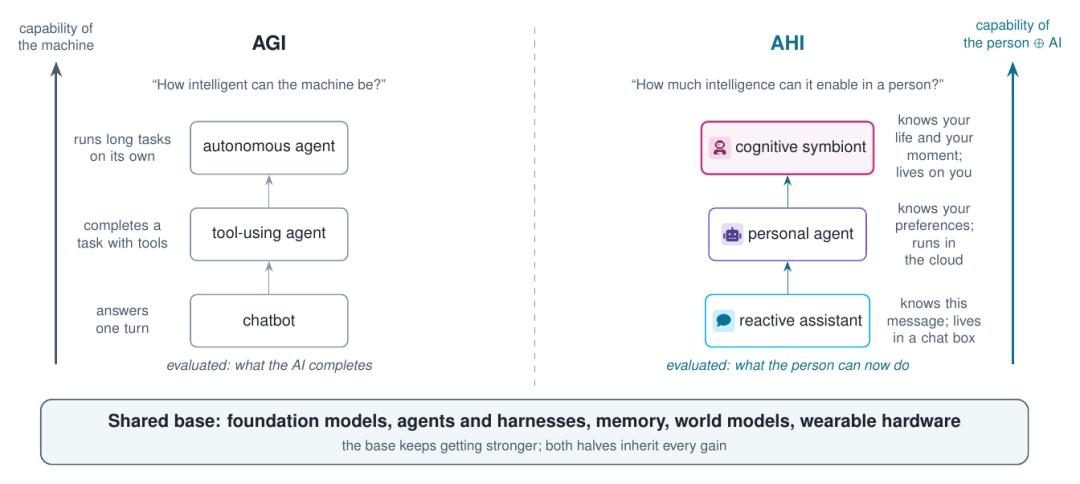
He names that endpoint AI-Augmented Human Intelligence, or AHI, and proposes a system form to reach it: the Cognitive Symbiont. The paper is titled From Autonomous Agents to Cognitive Symbionts: Toward AI-Augmented Human Intelligence.
AGI asks how smart a machine can become. AHI asks how smart a machine can make one specific person become.
A Jarvis that never asks you to explain
For a familiar image of the cognitive symbiont, the paper points to Jarvis in Iron Man. It is always present, has known its owner for years, and joins in while the owner speaks and acts, never asking them to stop and explain. The paper asks how to give everyone such a system and how far it should go beyond Jarvis.
The framing shifts the benchmark. A system’s value is no longer only what it automates, but what it leaves the human able to remember, decide and understand. An agent that performs tasks and an agent that extends a person’s cognition are different products, and only one currently gets serious research attention.
The industry is busy giving machines bodies. Fei is asking what happens when the augmented human is the deliverable.
Editor’s note: This is an adapted translation of the original 36Kr report. It has been trimmed and restructured for readability for an international business audience. The full original (in Chinese) is at https://36kr.com/p/4077424490877825.