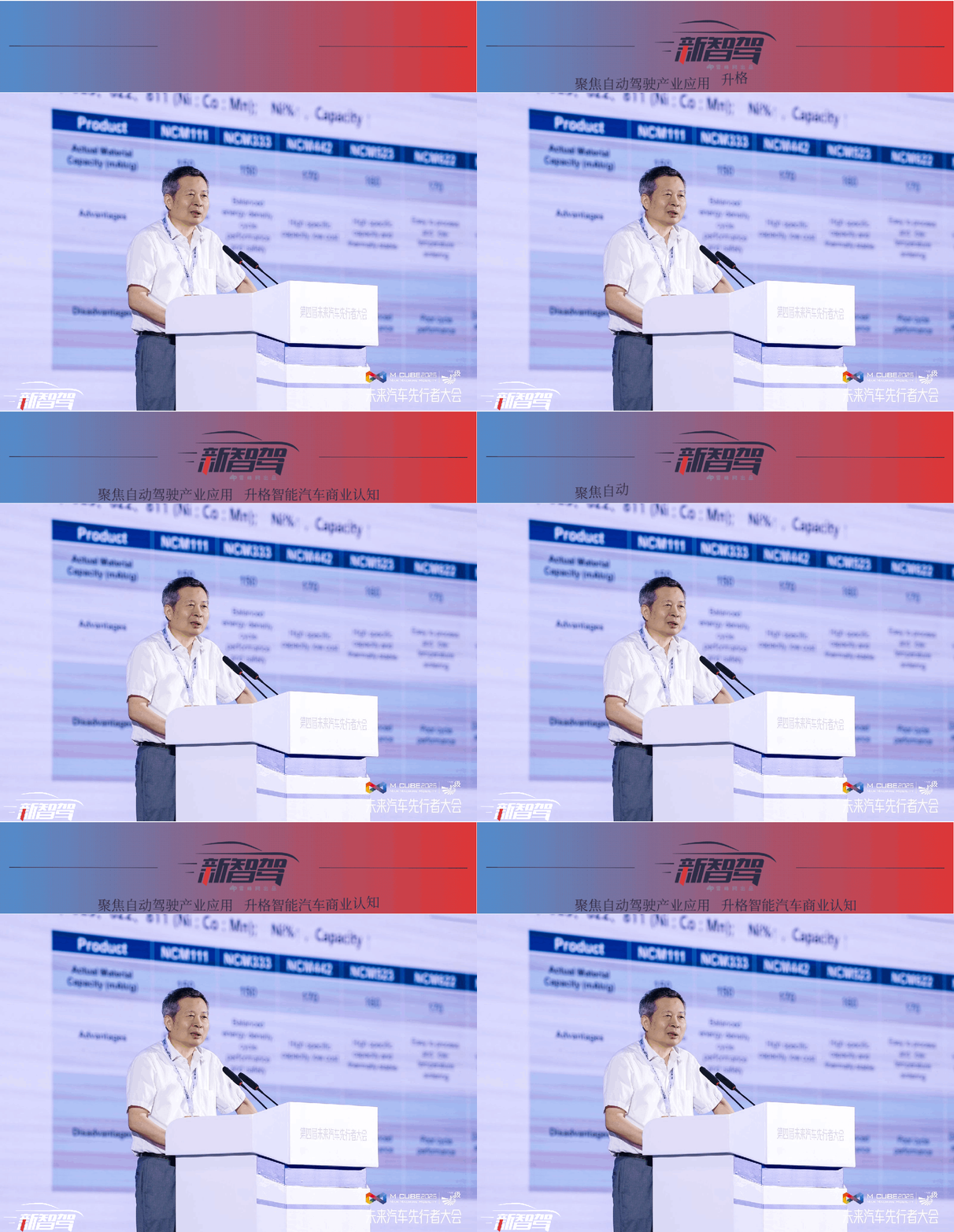
At a Shenzhen forum on the value of semi-solid batteries, Huang Xuejie, a leading Chinese lithium-battery scientist and convener of the CAS Institute of Physics energy-storage programme, argued that 2026 is the mass-production year for semi-solid (or ‘glassy-liquid’) cells, and that all-solid-state will not ‘overturn the table’ before 2035, so the industry must take semi-solid seriously now.
A new national standard effective this July classifies lithium batteries as liquid, semi-solid or solid, with semi-solid also called half-solid and solid meaning all-solid-state. The road map is explicit: 2026 for semi-solid volume production, 2030 for small-batch all-solid-state, and 2035 for next-generation solid-state in some affordable cars. Semi-solid comes in two paths, an all-inorganic solid electrolyte (oxides, phosphates) or a polymer gel, and the case for it is practical rather than exotic.
A bridge that reuses today’s factories
On the ternary side, a nickel-for-cobalt cathode (cobalt under 1 per cent, nickel above 95 per cent) lifts energy density to about 1050 Wh per kg while cutting cost; on the LFP side, a gelled electrode lets storage cells sit 20 years without failure and EV cells target above 10,000 fast-charge cycles. The decisive advantage is compatibility, today’s liquid lines need little change and run at over 90 per cent reuse, so China’s trillion-yuan cell infrastructure stays productive through the transition instead of being scrapped.
For European and global carmakers, the message is that Chinese cell makers are commercialising the bridge technology now, at lower cost and lower risk, rather than waiting for all-solid-state. That narrows the window for Western rivals to catch up on cell economics before the next discontinuity arrives around 2030.
Read the original report (in Chinese)
*Translated and adapted from LeiPhone (https://www.leiphone.com/category/transportation/xRrGlFlEHbWMo9SL.html).*