Sudo Technology’s WAIC debut: from one skill to ten, and the path to scalable general-purpose robotics
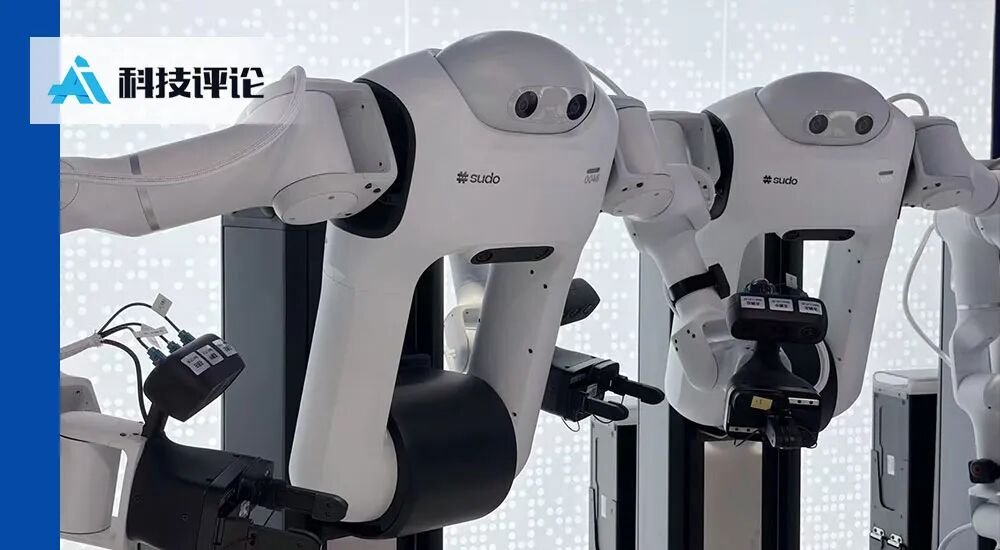
The embodied-intelligence zone at WAIC 2026 is still the most crowded floor in the hall. Robots make coffee, pose for photos and dance. Sudo Technology’s booth draws a crowd too, but the mood is different. Several robots stand quietly at workbenches, doing things that look almost ordinary: picking objects, wrapping something in cloth with both hands, inserting parts into matching holes. The motions are not flashy. What stands out is stability, success rate and generalisation.
This is not the first time Sudo has turned heads. In April, the company unveiled its full-stack embodied-intelligence platform, #sudo R1. In a 60-minute demo video, a robot continuously grasped more than 100 objects it had never seen before, including transparent glass cups, reflective metal parts, soft fabric and irregular toys, with a success rate close to 100 per cent. In June, at ICRA and CVPR 2026, Sudo demonstrated the system live to a global audience. When visitors placed objects randomly in front of the robot, the success rate stayed high.
Only a year after it was founded, Sudo has reached a RMB 20 billion valuation. That figure reflects both market excitement about embodied intelligence and the pedigree of its technical team.
Founder Hao Su is the most watched name. He is Haojing Distinguished Professor at Fudan University and the founding director of the Institute of General Physical Intelligence. He led the creation of ShapeNet and PointNet, foundational work that shaped 3D vision, and he has driven robot-simulation platforms such as SAPIEN and ManiSkill. His Google Scholar citations exceed 150,000. His research arc runs from 3D vision and spatial understanding to robot learning.
Sudo has also assembled the engineering and product side of the equation. Co-founder and CEO Zheng Han has a background at Microsoft Research Asia and in AI start-ups. Zexiang Xu, Vice-President of R&D and head of algorithms, was a research scientist at Adobe Research and has worked on 3D generation, spatial intelligence and foundation models.
From 3D vision and robot simulation to multimodal models and robot systems, Sudo appears to be building a complete technology stack aimed at general physical intelligence.
From one skill to more than ten in three months
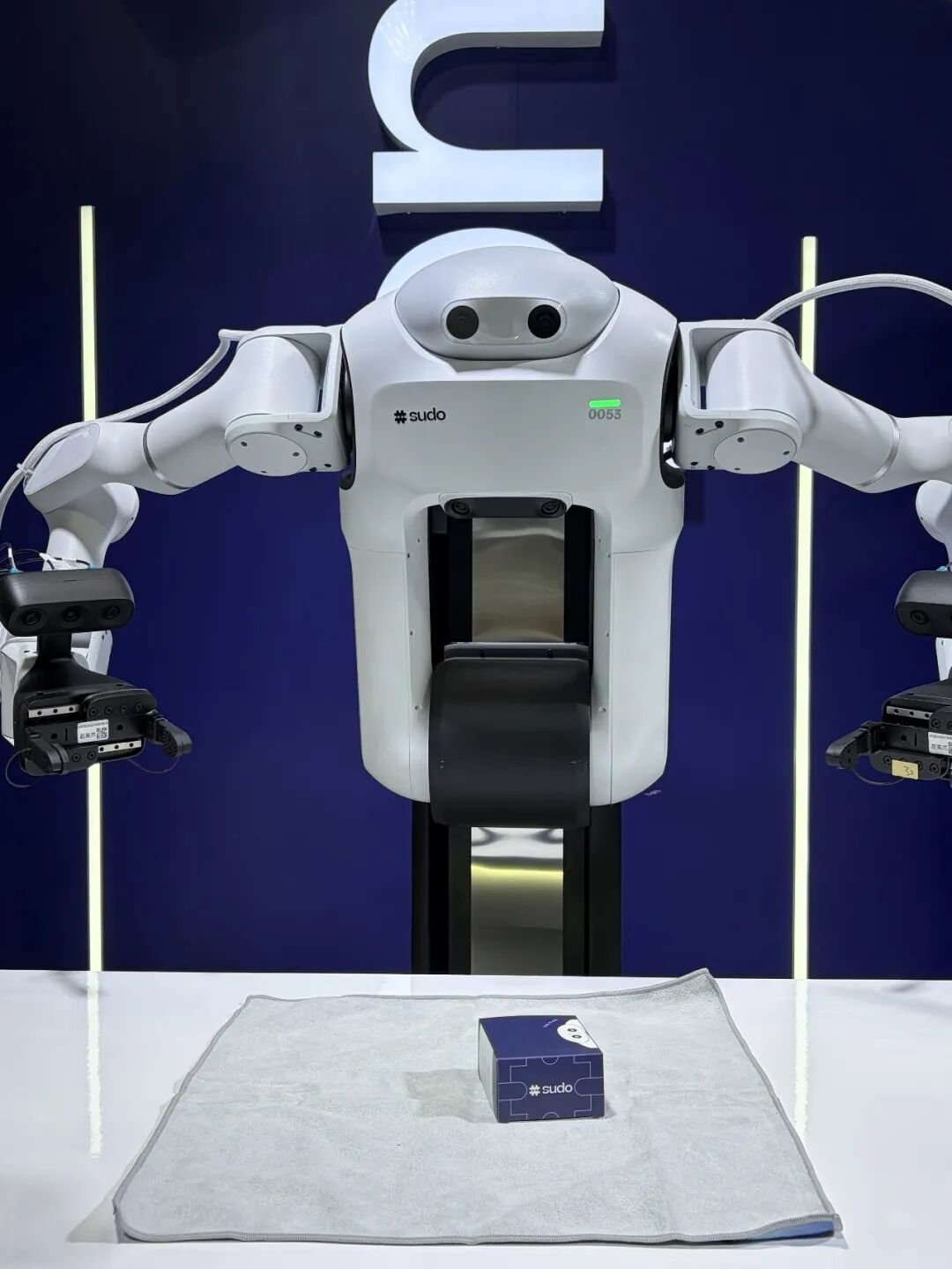
Precision placement. Flexible-object manipulation. Bimanual coordination. Mobile grasping. Autonomous navigation. At its WAIC booth, Sudo demonstrated more than ten skills at once, spanning home scenes, industrial lines, single-arm work and multi-robot collaboration.
Going from one to ten in three months is the kind of progress that gets attention.
Runze Chen, Sudo’s Vice-President of R&D and hardware lead, told AI Technology Review in an on-site interview that Sudo defines the basic units of a robot’s physical ability as atomic skills. The idea is that a robot should not need an engineer to retrain it for every new task. It should learn more like a human, accumulating basic skills and gradually handling more complex ones.
In a keynote speech on 17 July, Hao Su argued that what physical intelligence really lacks is not more isolated task demos but a way to gather scattered knowledge into a systematic understanding of the physical world. Knowledge in the physical world exists at different levels, he said. The closer you get to manipulation, the harder it is to learn by observation alone. Knowing what to do is not the same as being able to do it with your hands.
That is the central challenge that separates robots from large language models. People learn to ride a bike, cook or use tools not by memorising fixed procedures but by gradually mastering balance, grip, force and coordination. Those accumulated abilities let us combine old experience to solve new problems.
Sudo wants to build a similar accumulation system: start from atomic skills, combine them into complex skills, and eventually support long-horizon tasks.
Gift wrapping, for example, looks like one task, but it breaks down into object recognition, grasping, pose adjustment, precise placement, bimanual coordination and contact control. Those abilities do not belong only to wrapping. They transfer to assembly, tidying, moving and many other tasks.
As Hao Su put it in his speech, the mission of physical intelligence is to give people back to people. On this path, what robots need to accumulate is not more motions but the ability to understand, manipulate and change the physical world.
Skills that stack like blocks
For robot abilities to keep growing, the data problem has to be solved first.
That is one of the deepest differences between embodied intelligence and large language models. Language models scale partly because large amounts of text already exist on the internet. Robots face a continuously changing physical world. A simple grasp contains visual information, but also mass, friction, contact state, trajectory and environmental constraints.
The industry has not yet settled on a single data strategy. Some bet on first-person video, arguing that everyday human videos contain rich physical interaction information. Some collect human-hand data to mimic fine finger movements. Others rely on teleoperation, with humans directly controlling robots to collect real-machine data.
Sudo has taken a less common route: let robots gain experience first in simulation.
Sim-to-real has long been one of the hardest problems in robotics. Simulation can generate training data quickly, but the real world contains uncertainties that are hard to model fully. Small differences in material, friction changes, force feedback during contact and random disturbances can all make a policy that works in simulation fail on a real robot.
The hard part is building simulation data that is close enough to real-world physics.
That is where Sudo’s team has deep experience. Hao Su earned his undergraduate degree at Beihang University and his PhD in computer science at Stanford. During his PhD, he led the creation of ShapeNet and PointNet, pushing 3D vision forward. Later, as a faculty member at the University of California, San Diego, he invested heavily in robot simulation and benchmarking, leading the development of SAPIEN and ManiSkill.
Those efforts matter partly because they explore how machines can learn physical laws in digital environments that better approximate reality. ManiSkill supports GPU-parallel data generation, simulating large numbers of robot manipulation processes quickly. SAPIEN combines a physics engine with robot-control interfaces, letting researchers train robots in environments closer to real interaction.
Sudo did not simply call existing simulation tools. It rebuilt a data-production system of its own, oriented toward robot learning.
In Sudo’s view, the real value of simulation is that it can provide a growth environment the physical world cannot easily replicate. A skilled worker does not become skilled by repeating one assembly motion on one line. He grew up touching many objects, environments and tasks. Robots need a similar process.
In simulation, the team can expose robots to many kinds of objects, lighting conditions, material properties and task combinations, letting the model build a foundation of physical-world knowledge in advance.
Sudo’s technical team explains that an object has countless attributes, but only some key variables usually determine whether a robot can finish a task. Whether something is graspable depends more on weight distribution, friction and geometry than on surface texture or other visual details. Through extensive experiments, the team hopes to identify those key variables and bake them into the simulation.
Sudo has now built a complete data-generation pipeline that produces millions of data points per day.
A strong simulation engine does not mean Sudo rejects other data sources. Runze Chen said the company follows a sim-plus-real fusion route: large-scale simulation data as the base, plus selected real-machine data to improve reliability and real-world adaptability. The result is a robot that has both the breadth of experience gained in simulation and the tactile feel refined on real hardware.
Once atomic skills are practised and verified at scale in simulation, they can be stacked and reused like blocks, migrating quickly to new task scenes. That is how Sudo has expanded its skill set so fast.
Hardware is becoming the extension of the algorithm
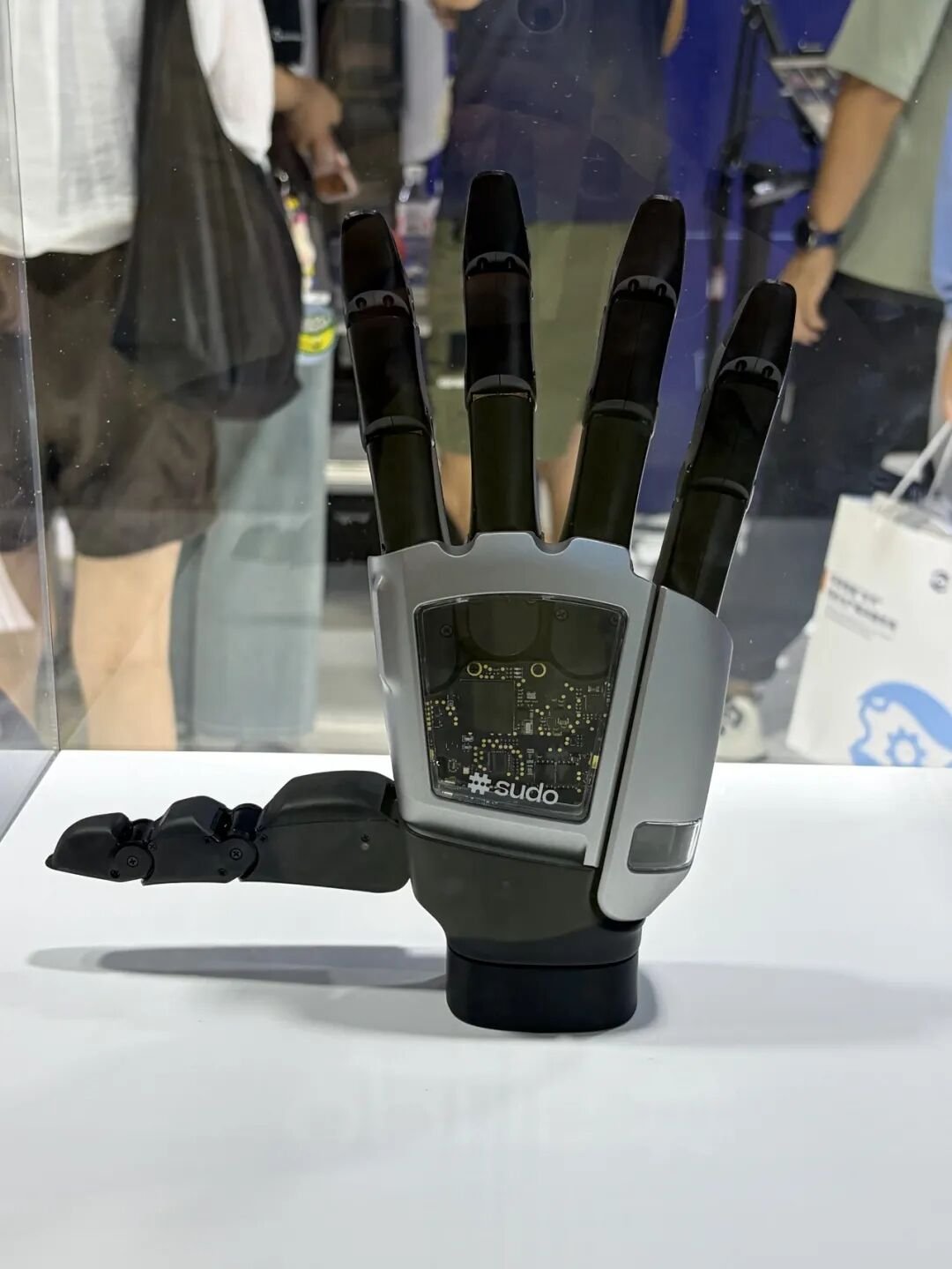
In a corner of the Sudo booth sits a self-developed dexterous hand.
It is a 22-degree-of-freedom direct-drive hand. The thumb and little finger each have five degrees of freedom; the other three fingers have four each. Compared with traditional grippers that only open and close, this hand aims to approach the capability of a human hand in complex manipulation.
Sudo’s hardware lead said the team did not simply copy human-hand structure. It redesigned for robot tasks.
The human thumb matters not only because it bends but because it forms stable opposition with the other fingers. So Sudo added a rotation degree of freedom to the thumb, gave the little finger stronger adduction, and designed the finger joints to abduct outward, giving the robot more contact area when holding objects and improving stability.
One easily missed detail is a nail-like structure at the fingertips.
For people, picking up a piece of paper with a fingernail, turning a page or lifting a small object off a table is almost automatic. For robots, soft fingertip pads often fail at such fine operations. A rigid nail-like structure helps the robot create a precise point contact, enabling tasks such as picking up a thin needle or pulling open a can tab.
On the drive side, Sudo chose direct drive.
Direct drive means the drive unit acts on the joint directly, without traditional reducers or transmission structures in between. Compared with transmission schemes that have mechanical backlash, direct drive makes the relationship between control input and joint response more direct, improving force control.
The hardware lead said the biggest value of direct drive is not just better mechanical performance. It is that the algorithm can use it more easily.
A robot control model needs to understand how much force produces how much motion. With complex transmission structures in between, the model sees a result that has been transformed many times. Direct drive reduces those uncertainties, letting the algorithm control the robot more precisely.
That is why Sudo insists on hardware-software integration.
As Runze Chen said in the interview, suppliers are capable, but they are too far from the need. They cannot talk directly to the algorithm team.
In the traditional industrial-robot era, hardware and software could be relatively separate. Robots repeated fixed motions and systems ran for years. General-purpose robots face open environments, so models, data and hardware must iterate together. If a model finds a class of tasks hard, the control strategy may need to change. If control requirements change, the mechanical design may have to change too.
Sudo therefore emphasises white-box design, meaning every part of the robot system can be understood, adjusted and optimised.
That choice is not just about full-stack self-development. The hardware team said the dexterous hand is not meant to replace industrial grippers in factories in the short term. It is meant to better serve software-algorithm training and iteration.
In Sudo’s view, in the embodied-intelligence era, hardware is no longer just a tool for executing model commands. It must co-evolve with the model.
From the robot body to data collection, model training and final deployment, Sudo wants to maintain control because hardware design directly affects model capability. Where a camera is placed, how many views it needs, how many degrees of freedom the arm needs and how each joint of the dexterous hand is designed are not purely mechanical questions. They must be decided together with algorithmic needs for perception, control and task execution.
When a robot fails, the team needs to judge quickly whether the model misunderstood the task, the control strategy was insufficient or the hardware feedback did not match expectations. Only by owning the full chain from mechanical structure and sensors to algorithmic models can the iteration cycle be shortened.
That hardware-software coordination was especially visible in the bimanual precision-assembly task demonstrated at the booth.
On the surface, the robot was simply inserting two parts into matching positions. Behind it were visual localisation, bimanual coordination, pose adjustment and contact control. Part tolerances, vision errors, mechanical errors and force feedback during contact all affected the result. For a person, such operations rely on long-formed bodily experience. For the robot, they require hardware, algorithms and data to converge on the same capability.
Sudo’s version of hardware-software integration is therefore not simply owning every module. It is making the robot’s body truly part of how intelligence is formed.
For now, most of the robots on display still use grippers as end effectors. The self-developed dexterous hand was the team’s first public appearance. The technical team said Sudo will explore wider application of the dexterous hand in its robot systems, using higher degrees of freedom and finer manipulation to replace traditional grippers and support more complex, open-ended tasks.
Fast industrial landing rests on 99 per cent-plus reliability
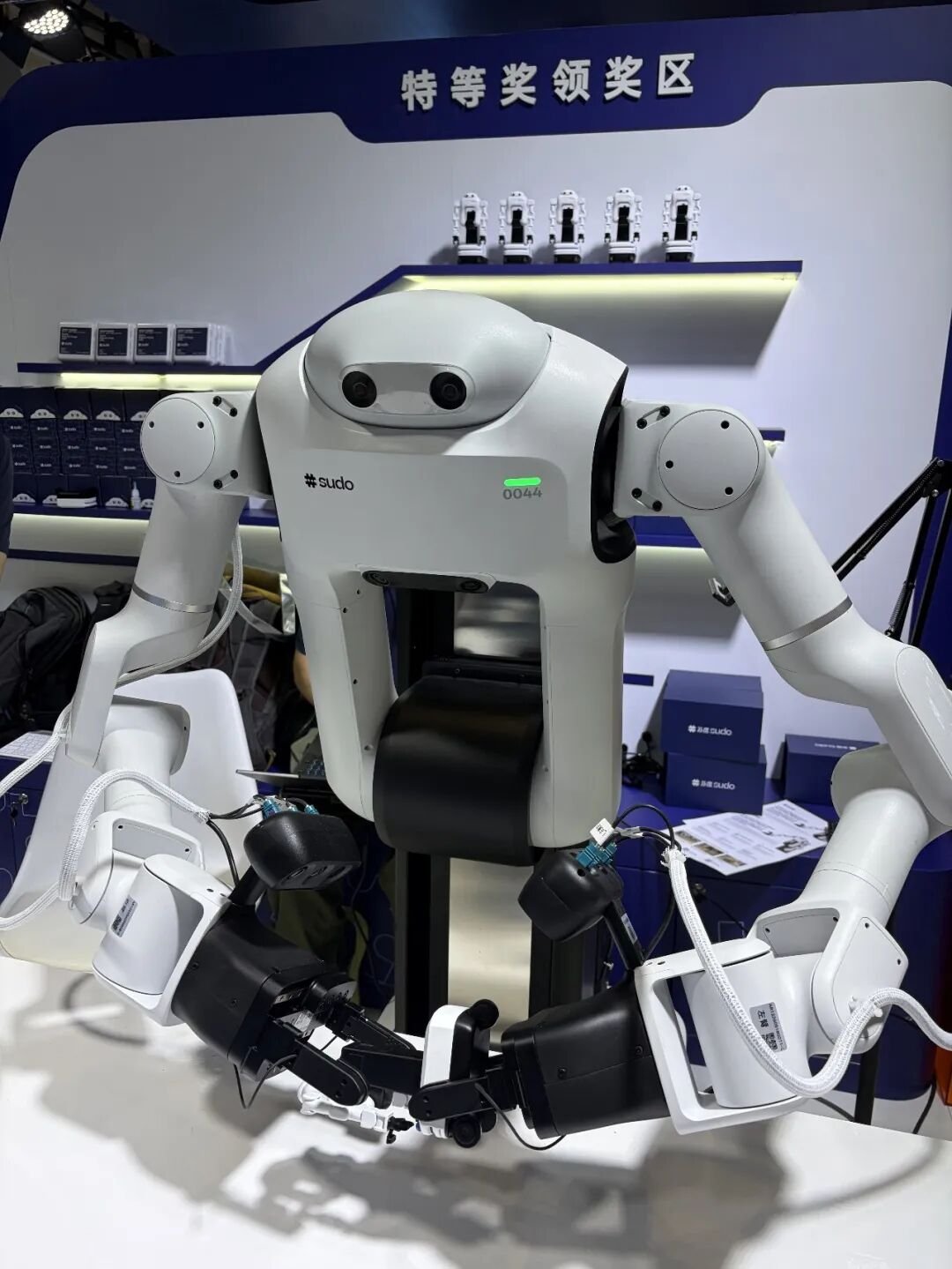
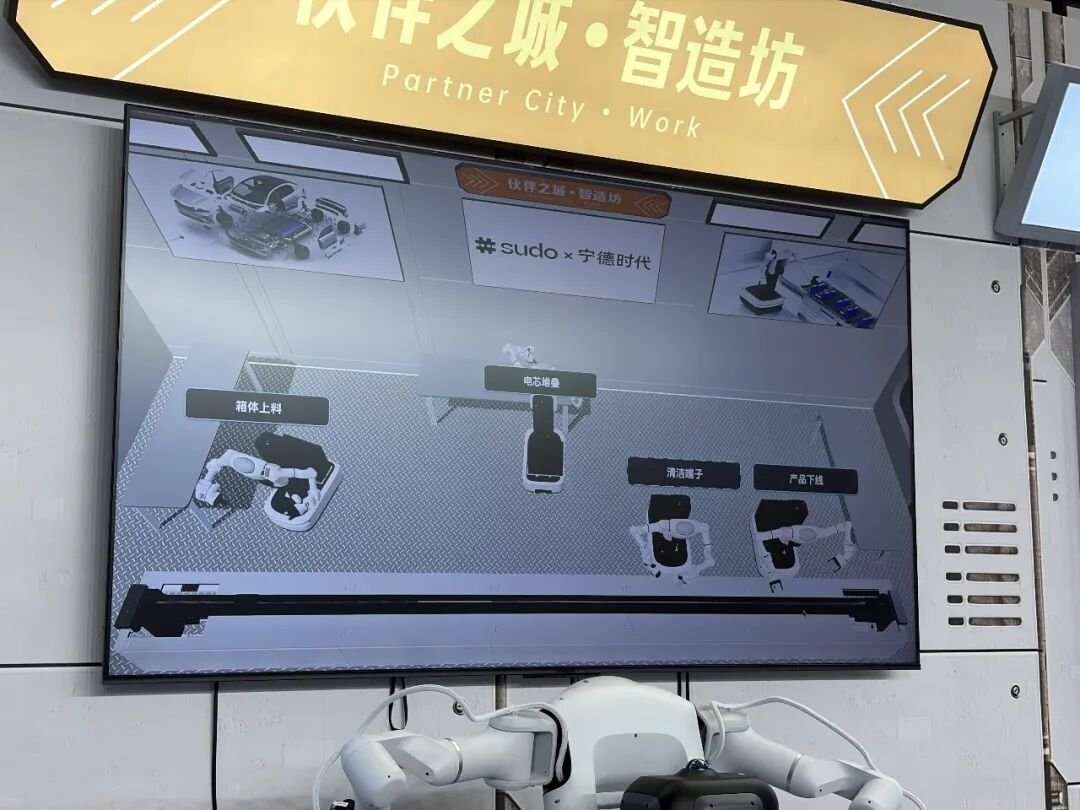
In the industrial-application zone, Sudo’s battery-assembly robots in partnership with CATL were running. Four robots stood at different stations, working together on lithium-battery module assembly. This was not a stage performance. It was a solution already validated on CATL’s lithium-battery production line, with a grasp success rate above 99.5 per cent.
In retail and supermarket scenarios, Sudo is working with a leading global retailer on technical planning for tasks such as inventory checks, restocking, shelf inspection and out-of-stock identification. In food-service stores, it is also advancing service-robot projects with leading chain brands.
Sudo’s team knows the gap between a demo and large-scale deployment is large.
As Runze Chen put it, the distance from 90 per cent reliability to 99 per cent-plus is a whole universe.
On a production line, one failure can mean a stoppage, rework or higher costs. Robots must handle changing object positions, changing lighting, changing equipment states, human interference and unexpected situations they have never seen. What decides whether a robot can be deployed at scale is often not the average success rate but the last few percentage points in the long tail.
That is why Sudo treats real deployment as part of model training, not as something that happens after training. Every customer site brings new environments, new problems and new failure cases. That data goes back into training and raises the success rate for the next deployment. The real world gradually becomes part of the closed loop of capability growth.
Sudo makes an interesting distinction: home robots and consumer-facing robots are not the same thing. DJI, for example, sells to consumers but is not a home-robot company. Robots may enter selected consumer scenarios before they truly enter homes, and crossing the home threshold still requires clearing hurdles on cost, safety, reliability and generalisation.
For a long time, therefore, industry, retail and commercial services will be the most important proving grounds for embodied intelligence. These scenarios create real value while continuously feeding models feedback that drives new capabilities.
Sudo’s target is hundred-unit deliveries in 2027 and thousand-unit scale in 2028.
More than the numbers, Sudo’s leadership cares about whether robot capabilities can scale alongside deployments. If entering each new customer requires collecting new data, retraining models and rebuilding systems, then scale is still project-based. Only when the same underlying capabilities can migrate quickly across scenarios, and new scenarios need less and less new data, will the industry truly enter a stage where capabilities are replicable and scalable.
Entering the era of capability growth
Sudo’s first public appearance in China reads like a declaration.
It wants to test whether a robot, equipped with transferable, combinable basic skills, can acquire more complex abilities through continuous stacking and eventually achieve general generalisation.
Toward that goal, Sudo has chosen a relatively complete technical route: a sim-plus-real data system to improve model generalisation, hardware-software synergy to shorten iteration cycles, and continuous validation of model boundaries in real scenarios.
Industry consensus has not converged, but what will determine a robot company’s competitiveness may no longer be how many demos it shows today. It may be whether, six months from now, it can still acquire new skills at the same speed, and whether, a year from now, those skills can reliably enter the real world.
Sudo Technology is answering that question in its own way.
Original source: LeiPhone (Chinese).
Translation note: This article has been edited for length and readability while preserving all key facts, figures, quotations and source attributions. The original Chinese source is LeiPhone (leiphone.com).