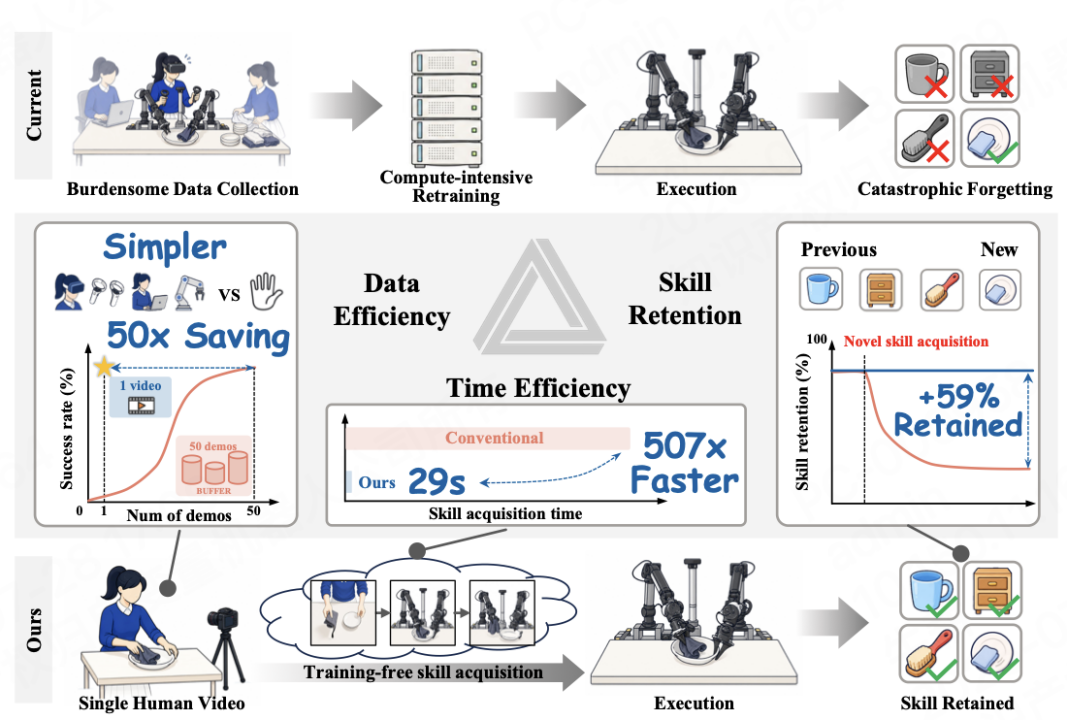
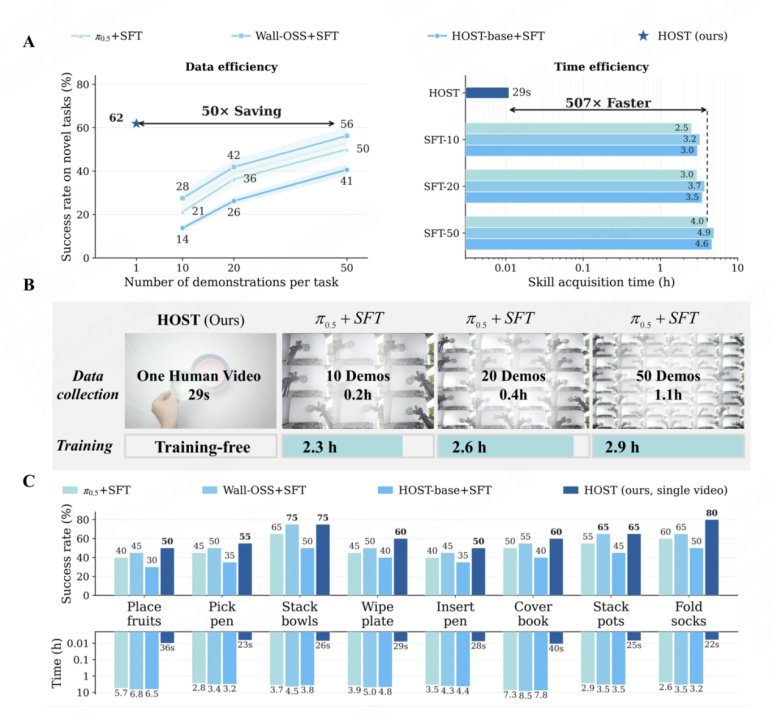
X Square Robot has open-sourced HOST, a framework that lets a robot watch one short video of a human performing a task and learn to replicate it, without retraining the model. In tests, a single 29-second demonstration video yielded a 62 per cent success rate on novel skills, using only one-fiftieth of the data and one-five-hundredth of the training time of comparable fine-tuning approaches.
HOST, short for Human-to-robot One-Shot Skill AcquisiTion, represents a shift in how robots learn from humans. Traditional approaches try to translate human motion directly into robot joint trajectories. HOST instead focuses on understanding the outcome of the human action, then planning the robot’s own motions to achieve that same result.
Result-first, not motion-first
When a human picks up a cup, HOST does not track how fingers bend. It registers that the cup moved from table to hand. It then converts that outcome into a target image from the robot’s own perspective and reverse-engineers the required joint movements. Visual outcome becomes the intermediate language between human demonstrator and robot executor.
This matters because humans and robots have fundamentally different bodies. A human uses five fingers. A robot may have a two-prong gripper. Different robot form factors, humanoid, wheeled dual-arm or single arm, will complete the same task differently. By anchoring on result rather than motion, HOST lets each robot find its own path to the same goal.
Task-progress alignment, not time alignment
Humans and robots execute at different speeds. If alignment were temporal, a robot running slower would see future steps prematurely and lose synchronisation. HOST aligns by task progress instead, mapping each frame of the human video and each step of robot execution into a shared vector space and matching them by progress stage, not by timestamp.
The approach reduces temporal alignment error by roughly an order of magnitude. Even when individual steps slow down, the robot continues at its own rhythm without losing track of where it sits in the overall task.
Dual-expert cascade architecture

HOST’s core is a cascaded policy model with visual prediction capability, built on a dual-expert Mixture-of-Experts architecture. One expert, the “video expert”, reads frames, judges task progress and predicts likely outcomes. The other, the “action expert”, translates those outcomes into robot motion commands.
Training happens in two phases. First, same-body pre-training, where the model learns from videos of the robot executing tasks, predicting next-frame outcomes and learning the actions needed to reach them. Second, human-robot video training, where the model learns to map human demonstration outcomes onto robot-perspective goal images and generate corresponding actions.
Crucially, once pre-training is complete, model weights are frozen. Learning a new skill happens entirely at inference time. The demonstration video becomes a callable recipe. Switch tasks, switch videos. No retraining.
Why skill retention changes the economics
Fine-tuning for new skills carries a hidden tax: catastrophic forgetting. When model parameters are updated for a new task, performance on previously learned skills degrades. Tests show Pi-0.5 with fine-tuning retains only 17 per cent of old-skill proficiency after learning a new one. HOST, because it never modifies weights at inference time, avoids this trade-off entirely.
Across 50 tested tasks covering different objects, tools and base actions, HOST demonstrated learning capability throughout. Success rates stayed above 50 per cent even when lighting, objects, scene layout and object positions changed, and when objects were mid-task displaced, indicating genuine state-aware planning rather than memorised trajectory replay.
The home robot implication

Households are not standardised production lines. Every home has different items, layouts and habits. If a robot needs fresh data collection and model fine-tuning for each new skill in each new environment, deployment cost stays prohibitive and rollout timelines stretch indefinitely.
HOST aims to compress that workflow into one human demonstration. A person who can perform the task simply does it once on camera. No programming. No trajectory recording. No model retraining. The robot watches, understands the intent, and plans its own execution.
X Square has published the HOST paper and open-sourced the code. The framework is not a finished product. Sixty-two per cent success rate leaves considerable headroom. But it demonstrates a concrete possibility: that visual understanding and reasoning, not endless parameter tuning, could become the more efficient path for robots to acquire new skills. When robots start learning through observation rather than repeated fine-tuning, embodied AI gets materially closer to everyday life.
Editor’s note: This is an adapted translation of the original OFweek Robotics report. It has been trimmed and restructured for readability for an international business audience.