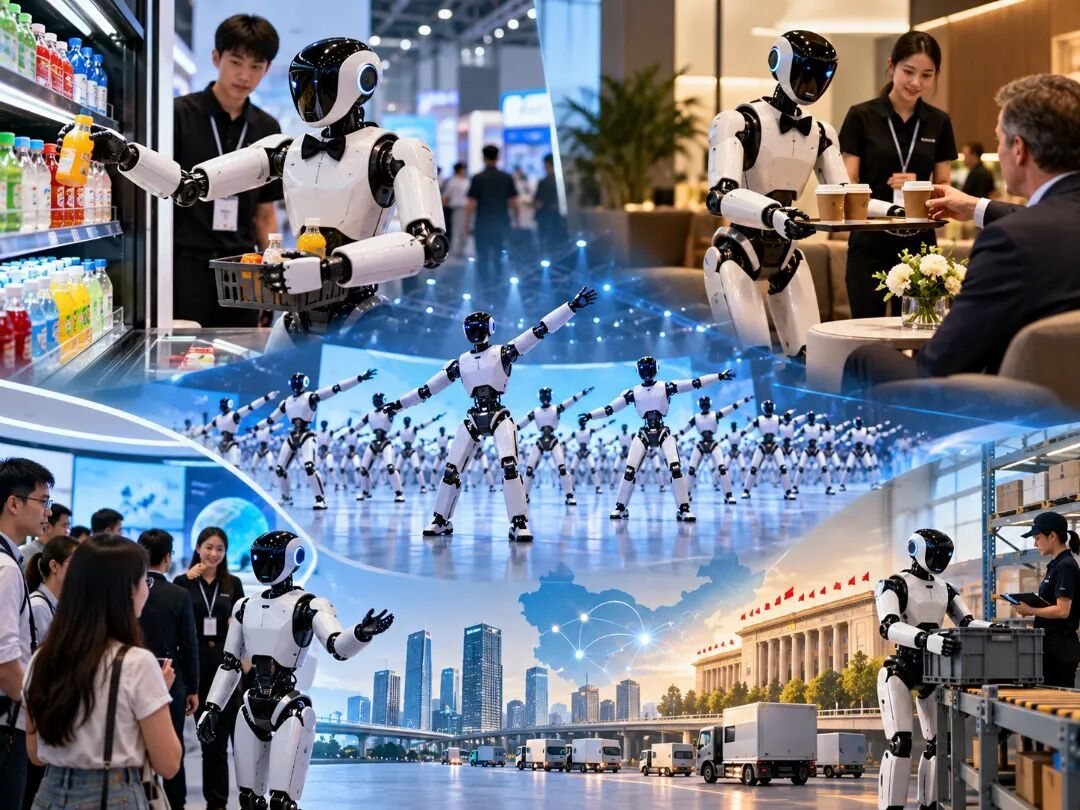
At the 140th Canton Fair, a humanoid wearing a black bow tie served drinks from a retail shelf while a second handed coffee to foreign buyers in the VIP lounge. Both were supplied by Guangzhou Zhidong Weilai, the session’s humanoid service partner, running five scenarios at once.
The detail worth reading is not the robot. It is that a member of staff stood beside every station, close enough for a visitor to turn from watching the machine to asking a human how it performs.
The minders are the message
Two years ago the standard humanoid appearance was a launch stage, a pre-scripted trajectory and a lighting cue, with failures edited out. This year the machine was placed inside a trade fair that has run for seventy sessions and left there for the duration, with a person on hand in case it broke.
That is a harder claim than a demo. A company willing to show the fallback publicly is signalling that the fallback is temporary, and that the measure of progress is how often it is needed.
Four events, one word
In January, Dobot’s Atom entered a cinema in Shenzhen. On the company’s disclosure, later carried by multiple outlets, it worked 14 consecutive hours without assistance, without a pre-set trajectory and without teleoperation, sold more than 1,000 cups of popcorn and took over RMB 20,000 in a single day. The company called it the first fully autonomous operation in a complex commercial environment.
On 24 October, AgiBot put 110 Expedition A3 units through a synchronised routine at the Jinan Yellow River International Convention Centre, taking a Guinness record for the most humanoid robots dancing simultaneously. Wang Chuang, a partner and senior vice president, stressed two points: every unit was a production model rather than a specially tuned demonstrator, and the choreography ran on the company’s own cluster scheduling with centimetre-level positioning, so a dropped unit triggered automatic local formation compensation.
Policy moved in the same direction. In June the Ministry of Industry and Information Technology and the State-owned Assets Supervision and Administration Commission launched a 2026 programme for real-scenario humanoid and embodied intelligence training, covering ten provinces and municipalities plus relevant central enterprises, with a target of representative scenarios completing application validation and routine deployment by the end of 2026 and enabling deployment at the 10,000-unit scale. On 19 October, the Ministry of Commerce and eight other departments issued eighteen measures on technology-enabled commerce, naming home services and commercial logistics as embodied intelligence targets while introducing tiered governance for commercial agents.
The shipment numbers and the composition problem
IDC’s global humanoid robot tracker, published on 29 September, put first-half 2026 shipments close to 25,000 units, up 432.1 per cent year on year, with a market value above USD 740 million. China accounted for more than 19,000 units, about 77.9 per cent of the global total, and Chinese manufacturers supplied over 95 per cent of worldwide shipments.
The composition is less flattering. Research and education, performance and display, and government-funded data collection centres made up the bulk of the half. Those are real purchases and they are not a labour market. A unit bought to train a model or to stand on a stage does not test whether the machine can hold a job.
What has changed is that a growing share of deployments now come with an operating clock, a revenue figure and an unattended-hours count attached. Those are the numbers that separate a shipped product from a moved unit, and they are the ones buyers will ask for next year.
Editor’s note: This is an adapted translation of the original OFweek report. It has been trimmed and restructured for readability for an international business audience. The full original (in Chinese) is at https://robot.ofweek.com/2026-11/ART-8321202-8420-30709612.html.