Most embodied model releases arrive with a video. Poke Robotics, a company founded this year, arrived with an interface instead, publishing RoboAPI and inviting the industry to try it.
The company calls RoboAPI an embodied API for the physical world. It ships alongside Poke-Aurora, the company’s own world-action model, and the two are meant to be used together: a developer attaches an arm, writes a sentence, and the arm attempts a task it was never trained on.
The problem the interface is aimed at
The persistent awkwardness of the last few years is that demonstration videos look excellent and deployment takes months. A university lab wanting to use an open embodied model has to collect data, fine-tune, validate, collect more, and repeat, and a month disappears before the first result.
Two walls produce that delay. The first is configuration. Robots differ in structure, sensors and control, and a change anywhere in that stack can make a model unusable. The second is generalisation, which tends to hold inside the objects and scenes a model has already seen and collapse outside them.
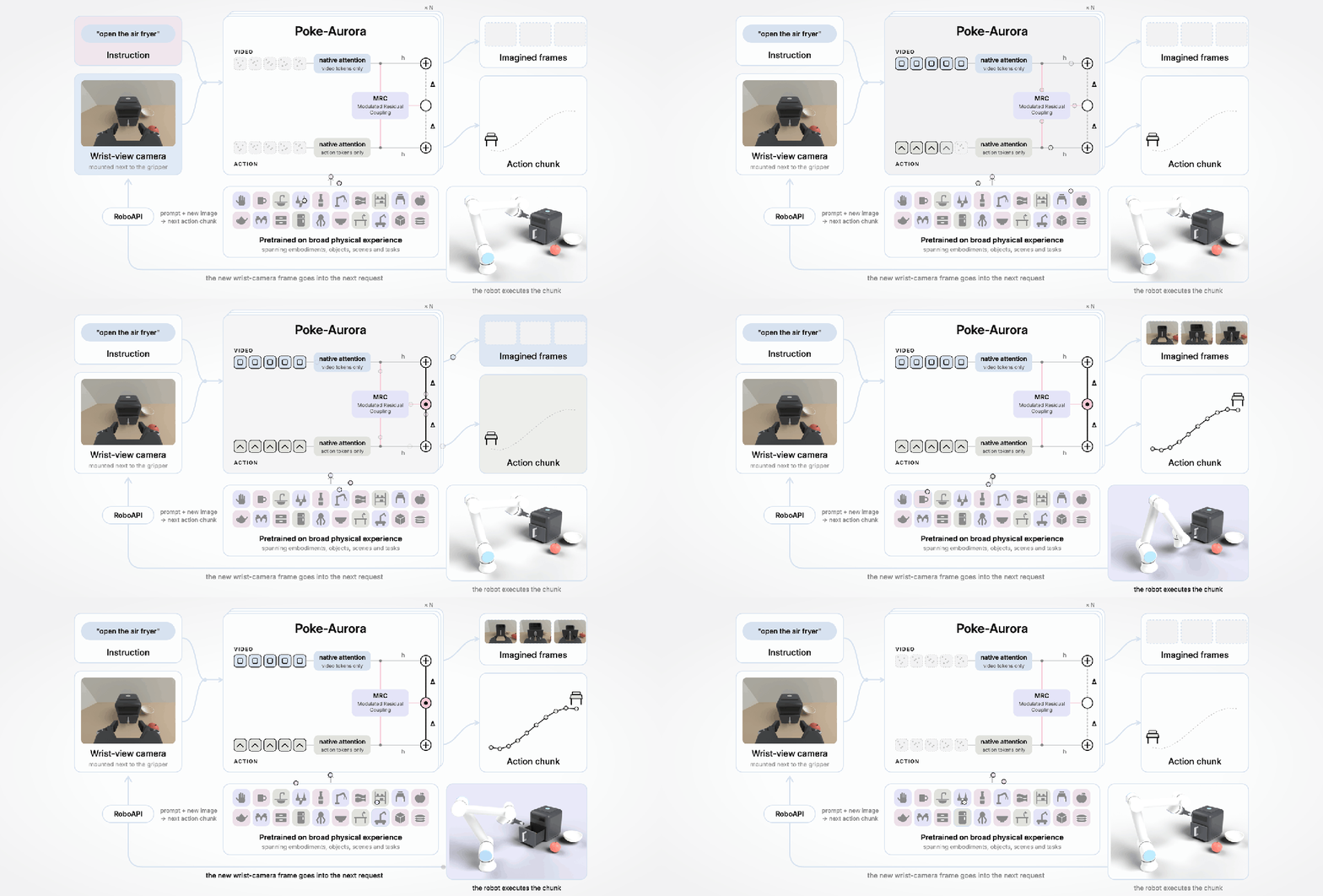
Encapsulating the model as a callable interface attacks both. According to the company, a developer plugs RoboAPI into a supported arm, supplies a prompt, and the arm completes an untrained task in an unfamiliar environment without data collection or training runs.
The numbers and where they come from
Poke’s own evaluation puts success at 86.0 per cent for object transfer and tidying, 54.1 per cent for pose and shape alignment, and 87.7 per cent for environment interaction and tool use. The comparison set is GPT6 Astra and two open-source embodied models, all of which the company reports below 35 per cent.
Self-reported benchmarks deserve scepticism, and the middle figure is the informative one. Pose and shape alignment is the category where every system currently struggles, and 54.1 per cent is a mid-range result rather than a victory lap.
The configuration makes the economics work. Inspired by UMI, Poke anchors observation and control at the gripper using a wrist-mounted fisheye camera plus end-effector pose control, which lowers both the hardware threshold and the setup cost. RoboAPI is free for non-commercial use.
Why the founder matters to the story
Xu Huazhe is an assistant professor and doctoral supervisor at Tsinghua’s Institute for Interdisciplinary Information Sciences, and one of the group the industry calls the Berkeley returnees. He took his undergraduate degree at Tsinghua, his PhD at Berkeley and a postdoc at Stanford, then spent years on general embodied intelligence.
Before Poke he was co-founder and chief scientist at Galaxea, a company that reached a valuation above RMB 20 billion and raised close to RMB 3 billion. He left while it was strongest, and the stated reason is the one that structures everything above: a general robot becomes general only after it has been tested in enough real environments, so the model has to be pushed into the world rather than kept behind a demonstration.
Turning a model into an API is the cheapest known way to manufacture that exposure. Every developer who connects an arm generates a failure case the company would otherwise have to buy.
Editor’s note: This is an adapted translation of the original OFweek report. It has been trimmed and restructured for readability for an international business audience. The full original (in Chinese) is at https://robot.ofweek.com/2026-11/ART-8321201-12003-30709565.html.