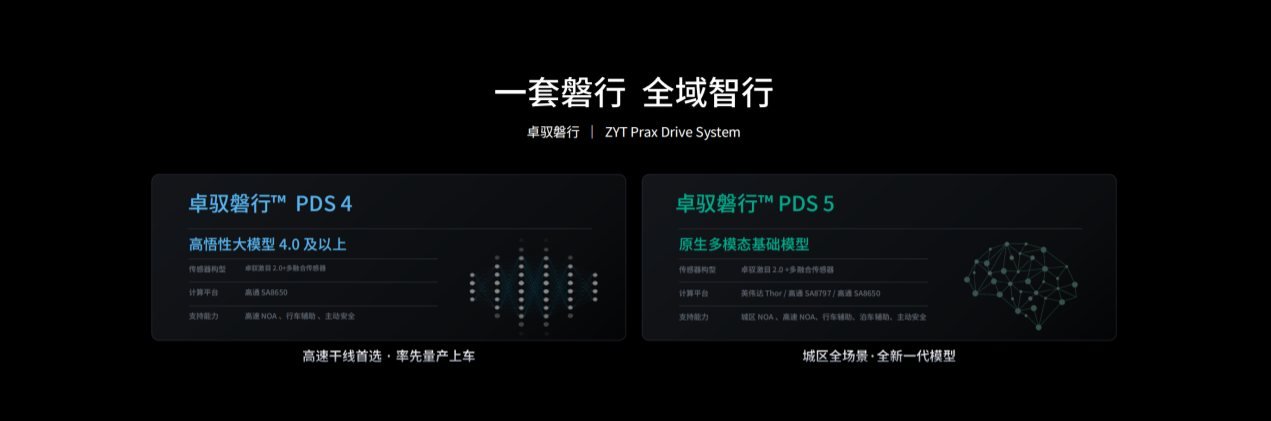
Zhuoyu Technology released its commercial vehicle assistance system, Pansing, on the evening of 29 October, alongside progress reports on heavy trucks, buses, light trucks and robovans. The system comes in two versions, and the split explains the strategy.
Two versions, one architecture
PDS 4 runs on the company’s fourth-generation high-comprehension model and above, supports highway navigation on autopilot, and targets long-haul heavy trucks. It is already in mass production.
PDS 5 runs on the next-generation native multimodal foundation model. It adds urban navigation, which matters for buses, light trucks and vans because those vehicles spend most of their distance on city roads rather than motorways.
Chief executive Shen Shaojie explained the timing with two penetration figures. Assistance systems in Chinese commercial vehicles sit below 1 per cent. In passenger cars, L2 and above passed 30 per cent some time ago. He expects the commercial segment to enter a faster growth phase within two to three years.
The logic is that a supplier already selling into passenger cars does not need to rebuild the stack. Cameras, radar, domain controllers and high-compute chips have all fallen in price, and end-to-end models have already shipped in volume. Moving that capability onto a truck is cheaper than starting again.
Why trucks are not just heavier cars
Liu Sikang, vice president of the commercial vehicle business, lists five difficulties. Data is scarce, perception range has to be longer, tolerance for error is lower, vehicle control is harder, and cost sensitivity is extreme.
A loaded heavy truck weighs around 40 tonnes. At highway speed the body is long, blind spots are large and braking distance is measured differently. Centre of gravity and dynamics shift substantially between empty and loaded states. A 17-metre semi-trailer introduces inner wheel difference and trailer sway into every turn and lane change.
Zhuoyu’s approach, in Liu’s three-part summary, is a unified base, scenario augmentation and engineering adaptation. The base is the passenger car model, retrained with roughly 400 million frames of truck-specific data laid on top of more than 30 billion kilometres of passenger vehicle mileage.
The perception hardware is a deliberate departure. Rather than mounting lidar outside the cab, Zhuoyu puts its Jimu 2.0 unit inside the windscreen, which protects the optics from rain, mud and gravel. The company claims 500 metres of detection range in highway conditions, including low-reflectance targets such as a stray tyre or a cardboard box.
Control required its own work. The system reads trailer attitude visually, estimates the angle between tractor and trailer, and adjusts steering, braking and power delivery against live load information. On gradients and winding roads it has to coordinate engine, retarder, auxiliary brake and service brake.
The number that closes the sale
No haulage operator buys assistance because it is technically interesting. They buy when it lowers diesel consumption, reduces incidents or reduces driver workload, and the first of those is the easiest to audit.
Pansing includes a fuel algorithm trained with reinforcement learning that decides when to lift off, when to apply power, and when to use the retarder or the brake, based on gradient, curvature, powertrain state and surrounding traffic.
Over two months Zhuoyu tracked more than 200 production heavy trucks across over 20 million kilometres. The reported saving is 4.5 to 7.5 per cent. At 800 km a day, that is about RMB 80 of diesel per truck per day, or RMB 20,000 to 30,000 a year. Adding reduced driver fatigue, fewer incidents and lower insurance, the company estimates payback in roughly twelve months.
Six manufacturers have signed: XCMG, Shacman, Sinotruk, FAW Jiefang, Foton and Dongfeng Commercial Vehicle. By Zhuoyu’s count those six hold over 93 per cent of China’s heavy truck market. Shacman was first to volume, with the Delong X5000 entering production in June and several hundred units now running Yunda express trunk routes. XCMG’s Hanjing new energy truck and Sinotruk’s high-end SITRAK are scheduled for production by the end of the year.
A payback period of one year is short enough to survive a procurement committee, which is a harder test than a demonstration drive.
Editor’s note: This is an adapted translation of the original Leiphone report. It has been trimmed and restructured for readability for an international business audience. The full original (in Chinese) is at https://www.leiphone.com/category/transportation/rwe6sLir6r3aYzeu.html.