While humanoid companies search for a customer, a machine that makes coffee has found 1,600 of them. XBOT closed a RMB 200 million A round and a near RMB 400 million B round, the largest funding recorded in food-service robotics, and its founder is unusually blunt about why.
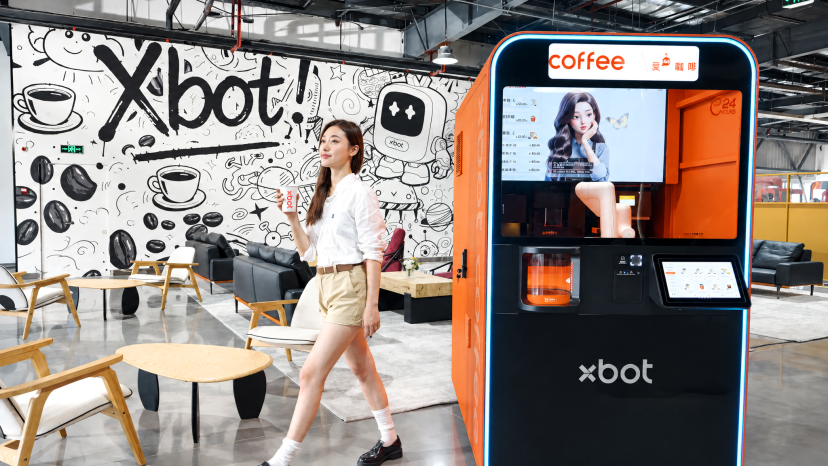
The product is a sealed unit under two square metres containing a coffee machine, ice maker and milk frother, with a six-axis arm handling cup, extraction, texturing and latte art. It produces a milk coffee in 46 seconds. A customer buys it for a little over RMB 100,000 and, in the company’s framing, gets a coffee shop without a barista.
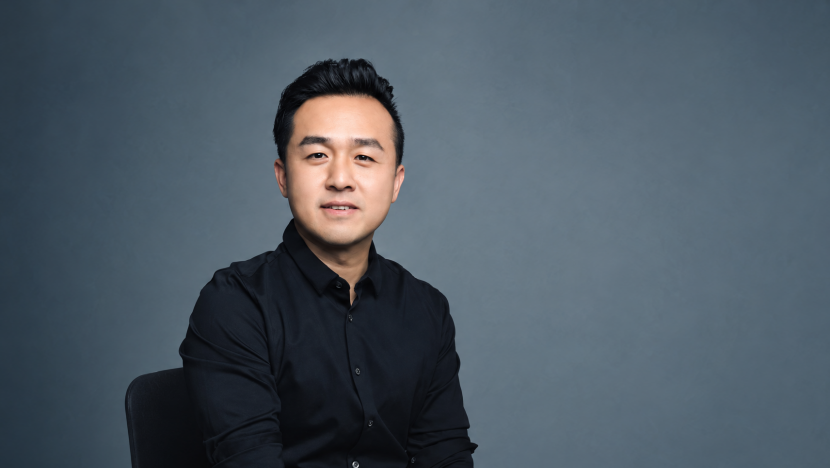
Founder Tang Mu is a 1977 graduate of South China University of Technology who built QQ’s penguin mascot and level icons at Tencent, then ran routers and smart speakers as an ecosystem vice president at Xiaomi. He started XBOT at the end of 2022, at forty-five, with an angel list that included Zhang Xiaolong, Lin Bin, Li Wanqiang, Huang Jiangji and Hong Feng.
Why coffee and not a humanoid
His account of the choice is a process of elimination, and it is the most useful part of the interview. Home was ruled out on safety and privacy. A humanoid needs a battery large enough to be a fire risk in a building where an electric scooter battery is already barred from the lift, and a house contains knives and plant pots. Industrial work was ruled out because he had spent years in it. A dark factory at night is full of large arms moving, placing and assembling, and a biped is a liability in that environment: a fall can stop a line for an hour at a cost of millions.
That left commercial service. Delivery, cleaning and pool robots already had incumbents, so he looked for something that survives a cycle. Food and drink always trade. Within that, drink has the repeat frequency, and within drink, coffee was the unserved growth market: per capita consumption in China rose from nine cups a year in 2019 to more than twenty, and the large chains still do not cover stations, hospitals, campuses and offices.
The proof point he cites is not a market study. A barista throwing coffee grounds at a customer was, to him, a signal that stores were squeezing labour to the point of collapse. When a productivity tool is missing for long enough, the pressure finds an outlet.
The cost curve is the product
The first unit in 2022 sold for RMB 700,000 to 800,000, a price at which nobody could earn a return selling coffee. Four years later the same function costs a little over RMB 100,000. Two things moved it. Annual hardware revisions nearly halved cost each year, and volume changed the supply conversation: before this product existed, the entire Chinese market for this class of arm was a few thousand units a year, and now a single order can be several thousand. Suppliers who had been burned by optimistic forecasts price against purchase orders, not promises.
At that price the unit economics of opening a shop change. A franchise of a major coffee chain costs RMB 400,000 to 600,000 once fees, fit-out, staff and rent are counted, and a bad location writes all of it off. A RMB 100,000-plus robot can be moved. One young operator can maintain it twice a day.
Delivery has followed the price. More than 1,600 robot shops are live worldwide, over five million cups have been served, confirmed orders for 2026 exceed RMB 300 million and recent monthly deliveries passed one hundred units, with more than RMB 20 million of revenue in a single month. Tang breaks the order book down as roughly RMB 100 million from anchor clients such as JD.com, RMB 100 million from franchisees and RMB 100 million from overseas and desktop products.
What separates this from a hardware sale is what sits behind the machine: a robot operating system, a cloud service centre and a digital store manager that recognises returning customers and is trained on behaviour across the whole estate. The company also handles installation and remote operations for franchisees who have never run a food business.
The correction he is pricing in
Tang’s read on the sector is that the tide has already gone out. Many humanoid companies raised on a story rather than a business, and the ones that cannot raise again will discover the difference. He is pointed about training costs too: his team trained the coffee task on about 200 hours of domain data, while he has heard of humanoid firms spending tens of millions of yuan on a single clothes-folding dataset, one task among hundreds needed for a general machine.
That is the argument worth taking seriously. A narrow robot with a paying customer generates the data, the service revenue and the iteration budget that a general robot is still asking investors to fund. It is a less exciting business and a much better test of whether anybody wants the output.
Editor’s note: This is an adapted translation of the original OFweek report. It has been trimmed and restructured for readability for an international business audience. The full original (in Chinese) is at https://robot.ofweek.com/2026-11/ART-8321203-12005-30709796.html.