The Empire that Forgot to Enter the Next War
Warren Buffett held BYD for seventeen years and exited in silence. The smartest investors I know are still arguing about whether BYD has won, but they are arguing about a war that is already over.
The story is not BYD versus Volkswagen, but that the auto industry has now been through two wars in fifteen years, and the legacy European empire missed both of them.
The first war, the one China won
From roughly 2015 to 2025, the global auto industry fought over the electric powertrain. The questions were familiar: who controls the cell chemistry, who scales the gigafactory, who can build a usable EV for under twenty thousand euros.
China won that war. BYD, CATL, and a dense ring of domestic suppliers industrialised the cell-to-pack architecture at a speed and cost no Western rival could match. Volkswagen discovered what every incumbent discovers, that you can license the technology but cannot import the supply chain that made it cheap.
The warning came early, in Zwickau. Over ten thousand finished ID.3s gathered under a tented lot the size of a football pitch, each one waiting for a technician to walk out with a laptop and a USB stick and patch its software by hand, six hours per car. Volkswagen had built the hardware but could not finish the code. CARIAD, the division created to solve exactly this failure, accumulated operating losses exceeding 8 billion euros by 2024 against a multi-year budget plan in the tens of billions, and repeated leadership reshuffles failed to ship a stable update.
That is what losing the first war looked like, not a dramatic defeat but a slow accumulation of capability gaps the organisation could not close.
The first war, in capital terms
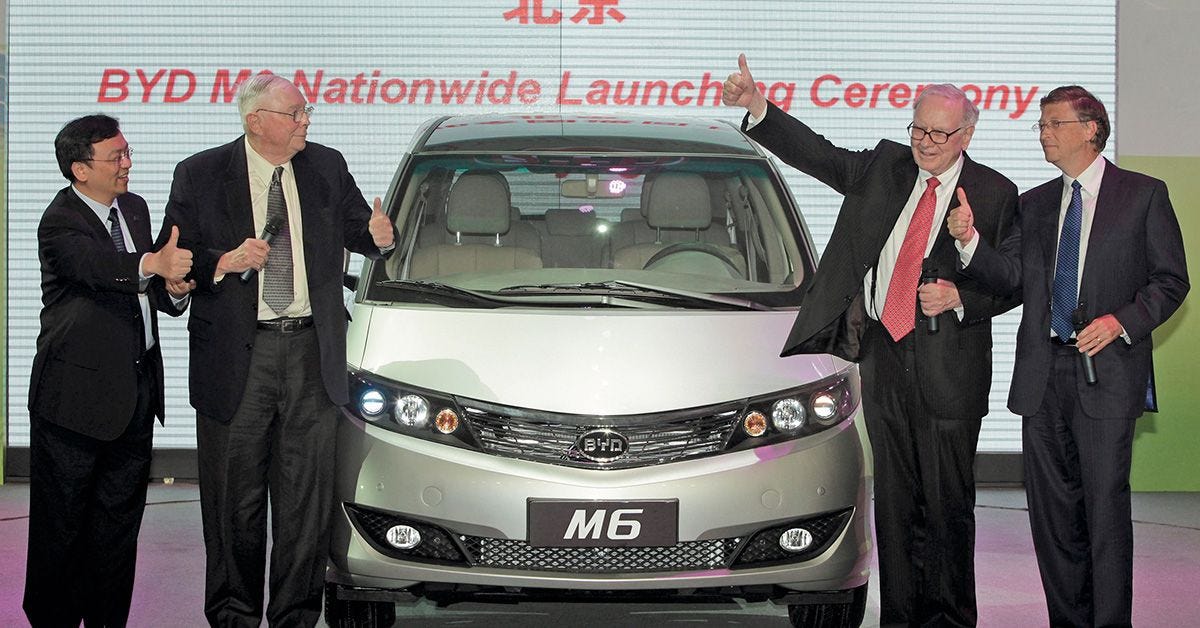
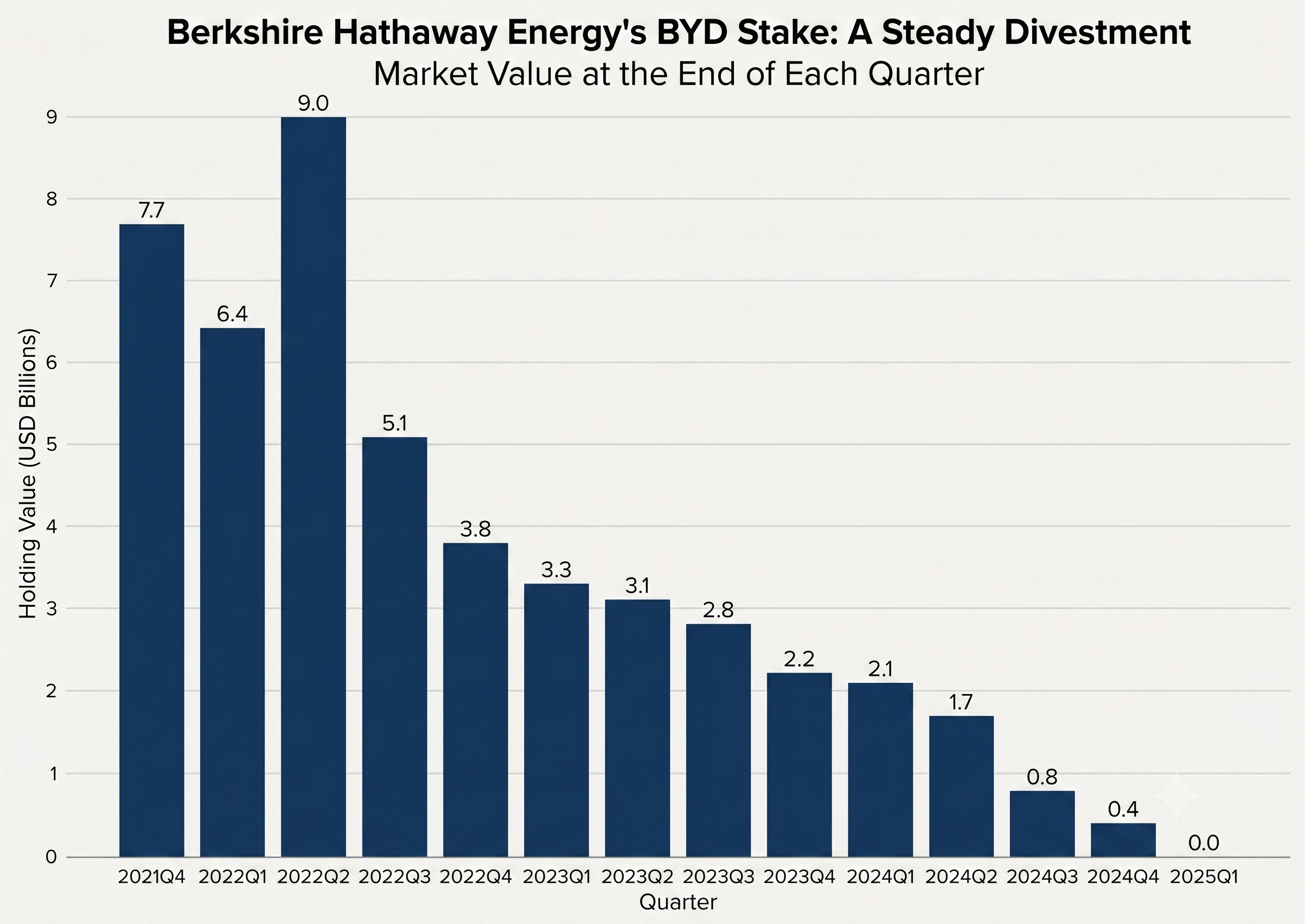
The capital markets saw this clearly. Warren Buffett’s Berkshire Hathaway disclosed on 21 September 2025 that it had fully exited its 17-year position in BYD. The original 230 million dollar stake from September 2008 had grown to roughly nine billion dollars at peak, a return of about 38 times. The exit was methodical, from the first sale on 24 August 2022 at an average of 277.10 Hong Kong dollars per share, through sixteen disclosed reductions, down to a sub five percent position in mid 2024, and finally to zero in the first quarter of 2025.
Berkshire never gave a public reason, but the timing is the message. Buffett bought the vertical integration thesis when BYD was unknown outside Shenzhen, and he exited the same thesis when the cycle had clearly matured. He understood the upside early, and the cyclical limit early too. It is interesting how few financial analysts flagged the liquidity vulnerability that BYD’s aggressive growth model carries into a mature phase, but then again, not all of us are Buffett.
This is the rare case where the capital cycle and the industrial cycle delivered the same verdict at the same time. The first war, the EV war, is over, and the marginal dollar has already been made.
The second war, the one nobody in the West has entered
The EV war is already over, though most analysts still do not see this. The cost of the battery as a percentage of vehicle value has collapsed, and in practical terms, building a standard electric car in 2026 is now remarkably similar to manufacturing a mobile phone. You choose your components from a small set of qualified suppliers, you assemble, you ship. Malaysia’s Proton and Vietnam’s Vinfast can now build vehicles that are arguably better than what Volkswagen offers, and they are, as the saying goes, Chinese EVs wearing Malaysian and Vietnamese skins. The point is that they work.
If the hardware is becoming a commodity, the profit pool migrates upward into the computing platform, the software stack, and the full-stack silicon that orchestrates the user experience, and this is the second war, where the battlefield is digital architecture rather than chemistry. Antony Blinken’s rule, if you are not at the table you are on the menu, maps onto Wolfsburg with surgical precision. Volkswagen failed to secure a seat at the digital table in time, and its later partnerships with Rivian, XPeng, and Horizon Robotics were admissions of that failure rather than evidence of recovery. If you are not writing the software stack yourself, your market share is inevitably what gets served.
CATL is the cleanest beneficiary of the first war’s conclusion, the jeans seller of this gold rush, equipping every miner. If CATL achieves an absolute scale advantage, it would make perfect financial sense for BYD itself to outsource lower tier cell production. The irony of a company that started as a battery maker buying back cells from a competitor is not far fetched. It would simply mark the moment that batteries, like petrol before them, became a cost line rather than a strategic moat.
Why the legacy model cannot catch up
The internal combustion industry was once vertically integrated. Ford’s River Rouge plant took in iron ore and rolled out a finished car, and Ford even founded Fordlandia in the Brazilian rainforest to run its own rubber plantation, the same logic that drives BYD to control lithium mines today. That experiment failed, and over decades, integration gave way to a complex global supplier network of Tier 1 and Tier 2 specialists. The ICE industry became a mature, modular, low risk business where supplier specialisation worked.
This view is historically accurate, but the analogy may not travel into the current era. The fragmented supplier model of the ICE age worked because parts like gearboxes, spark plugs, and dampers have clean physical interfaces. You can standardise a piston ring, and you can standardise a software interface too, but when you standardise across five Tier 1 suppliers, each running different code bases, different release cycles, and different commercial incentives, the result is a bloated architecture that upgrades at the speed of its slowest partner. This is the CARIAD catastrophe: each supplier builds the piece it was paid to build, and the integration becomes the original equipment manufacturer’s problem. Volkswagen’s own ID.3 software disaster was not a coding bug but the predictable output of a fragmented architecture.
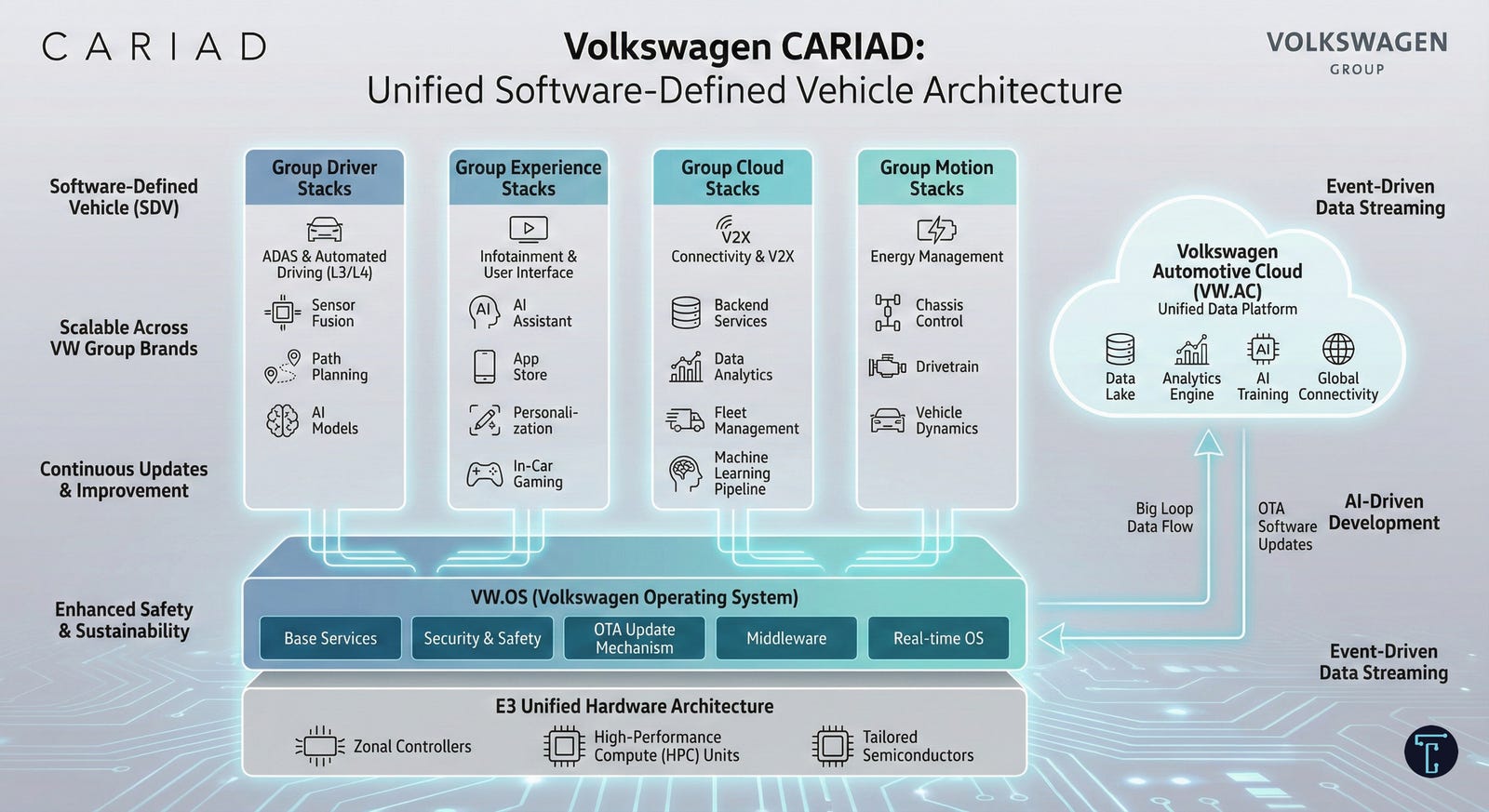
The deeper point is that supplier modularity is the right answer for a mature industry in a stable technological era, and the wrong answer for a frontier technology race. The smart car era is still defining its own standards, with the operating system, the central compute, the silicon, and the sensor fusion layer all in motion. In that environment, execution speed is the only durable moat. The vertically integrated closed loop is the only structure capable of that velocity. A code change in the morning reaches the vehicle over the air by the afternoon. The legacy modular structure cannot match it. Patching it with a software subsidiary does not fix the underlying architecture.
What an empire looks like when it ages
A comment on my previous newsletter captured this best. The Necromonger rule from the Riddick universe puts it plainly: you keep what you kill, and Germany’s industrial decline was a domestic consequence rather than a foreign conquest. The door stood open because the country severed its cheap energy, tolerated fraud in its emissions regime, cuddled its workforce into structural rigidity, and neglected the digital infrastructure, while its politicians, workers, and managers partied away from it.
The numbers bear it out. Industrial electricity in Germany ran near 0.25 euros per kilowatt hour in 2024, against roughly 0.08 in China. Oliver Wyman estimates German auto labour at roughly 3,300 dollars per vehicle, against 600 in China. These are not cyclical disadvantages but structural ones, and the proof arrived in late 2025, when Volkswagen shuttered its Dresden plant, the first German factory closure in the group’s 88 year history. The building did not burn. It was simply no longer affordable to keep the lights on.
And yet the deeper diagnosis is that these costs are, in principle, addressable. They are painful, politically explosive, but not technically insurmountable. The truly fatal cost is the one that compounds silently, the absence of a software stack. The hardware factories, the assembly lines, the engineering centres in Wolfsburg and Ingolstadt, can in principle be retrofitted, restructured, or shut down and replaced, but you cannot retrofit a codebase you never owned.
The real failure was not the open door, but the building behind it, running on a codebase no one in Wolfsburg ever wrote.
The quiet reallocation
The decade ahead will not be decided by a dramatic acquisition or a Schularick-style absorption. What is coming is a slow bleeding of share, market by market, segment by segment, as obsolescence does its quiet arithmetic.
Volkswagen will not disappear, but it will hollow out the way GM and Ford hollowed out. It will become a regional champion defending a shrinking perimeter, sustained by a generous welfare state, reliant on Chinese components, and structurally absent from the next architecture. BYD has no need to strike, only to keep building in Hungary, Brazil, Thailand, and Indonesia, while Volkswagen pays down its own pension obligations and watches its own factories idle. Each quarter, the European balance sheet weakens. Each quarter, the integrated challenger extends its lead in the only theatre that still counts.
The old empire did not lose the war. It simply forgot to enter the next one. And empires that forget to enter rarely come back to the table.
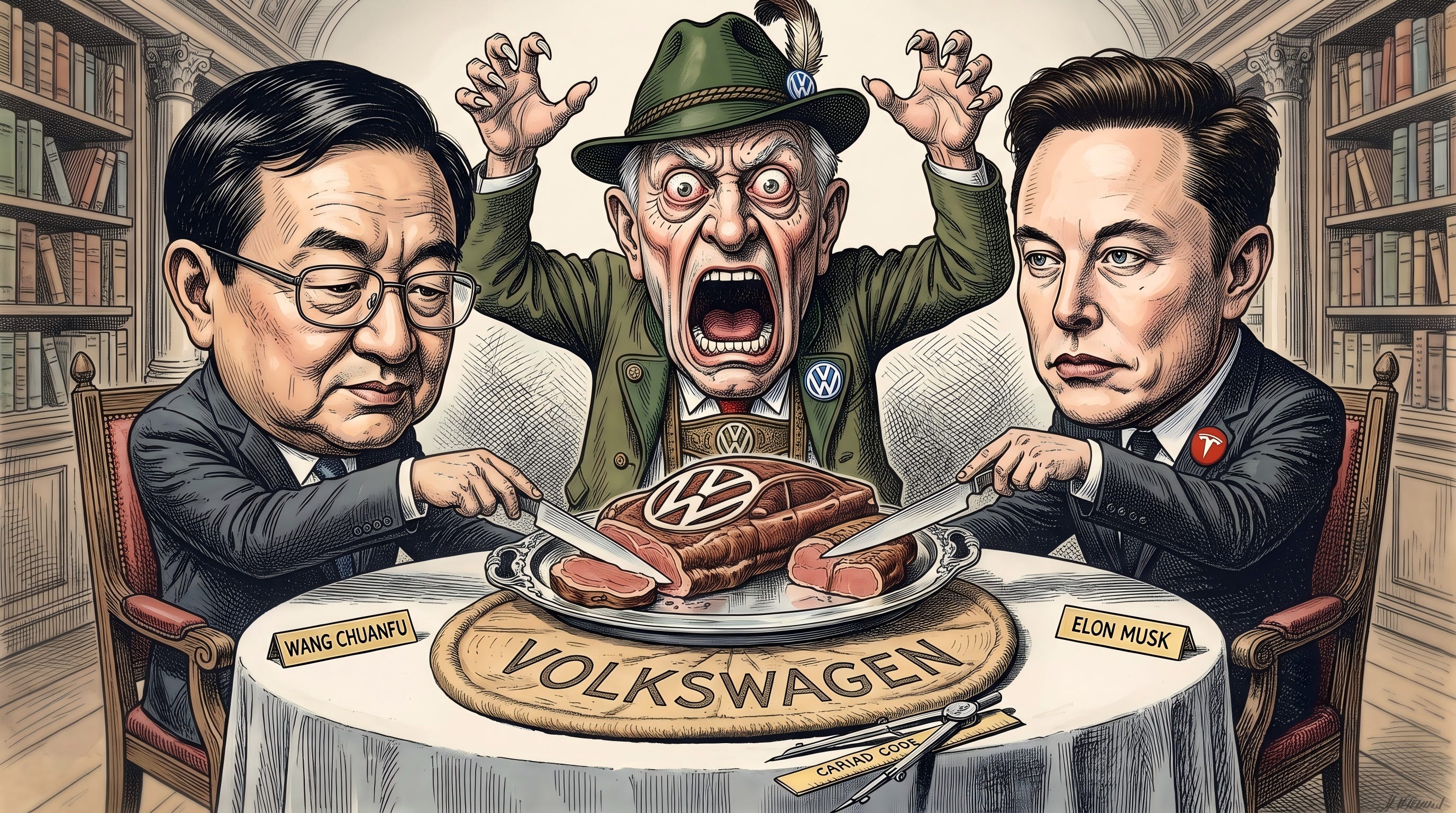
The table is set. The seats are taken. Volkswagen is on the menu.
Where do you think Volkswagen’s software bet actually pays off – or is the table already set? Reply and tell me which legacy maker you’d short next.