The IPO that finally surfaced
AgiBot (Zhiyuan Innovation), the humanoid star that repeatedly denied Hong Kong IPO rumours, finally confirmed in late July that it had started the listing process. Good news followed: its self-developed WITA-Omni Preview model topped Qwen, Gemini, Doubao and Nvidia with an 85.21 score, and it launched the world’s first robot wuxia IP.
What moved the market was a quietly updated partner list on its site: nine names, six with Huawei backgrounds. Founder Deng Taihua is a former Huawei vice president who built the Kunpeng and Ascend AI ecosystem; Peng Zhihua (“Zhiyuanjun”) came through Huawei’s genius programme. But two details stood out: chief scientist Luo Jianlan was missing, and the heads of the spin-out businesses were all present.
Money matters more
Luo Jianlan is a Berkeley PhD, ex-Google X and DeepMind, a student of Sergey Levine, who joined in April 2025 to lead the embodied-AI research centre. His strength is real-world reinforcement learning and data loops. But models sit awkwardly in AgiBot’s strategy. Unitree bundles everything into one IPO; AgiBot breaks apart, spinning out components, data, leasing and the dog business to fund and develop separately while the parent focuses on the model.
Since April last year, AgiBot has spun out five subsidiaries across cleaning, leasing, dexterous hands, data and quadrupeds. Qingtianzu closed five rounds in half a year at a 7 billion yuan value; Linjie closed four rounds past 1 billion US dollars; Mifeng raised several hundred million. Those two alone approach the parent’s 15 billion yuan body.
As the model head, Luo grew uncomfortable in a strategy that went from heavy to light. Not from Huawei, preaching that leaderboard scores are meaningless, he clashed with a company that must soon tell capital markets how it makes money.
Making the plate bigger
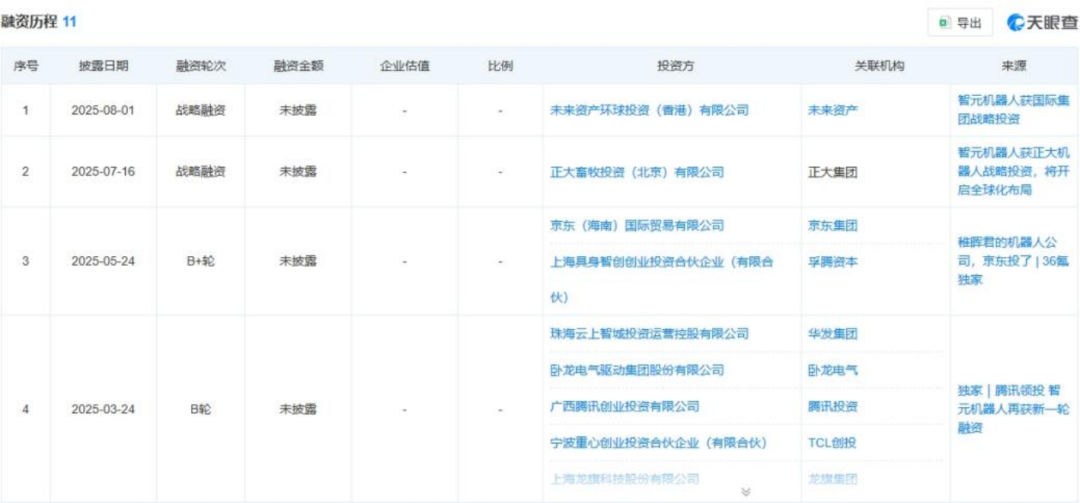
Since February 2023, AgiBot has raised 11 rounds; by the first half of 2025 its value passed 15 billion yuan, backed by Tencent, Hillhouse, Sequoia, BYD, JD, LG and CP Group. Yet all in one entity caps the ceiling. Despite leading on output, with 15,000 embodied robots in the first half of 2026, it still faces the common wall: heat and capital, thin deployment, profit far from expectations.
The fix is brutal but simple: don’t keep eggs in one basket. Spinning out dexterous hands, quadrupeds, data and leasing brings independent financing, relieves cash pressure, feeds orders back to the parent and binds old shareholders. IDC sees China’s quadruped market passing 700 million US dollars in 2026 (doubling), dexterous hands over 300 million (up 150 percent) and cleaning robots near 3.4 billion (up 18 percent). Data and leasing are the first to pay back.
AgiBot built a hard-market parent-subsidiary system: it buys data from Mifeng only by order, no free feed. That “brothers settle accounts” model forces subsidiaries to stand on their own. Linjie, post-spin, drew Tencent, Baidu Ventures, Yunfeng and SAIC. Suppliers double as investors: Longqi is investor, customer and supplier, taking AgiBot’s 15,000th robot into its 3C line.
The Apple-chain feed
The “invest plus supply plus partner” model shows most in the Apple chain. Lens Technology assembles AgiBot’s full humanoid range, co-founded a JV and invested in its Zhejiang unit. Lingyi went “four steps in four years” from deal to mass production, delivering over 5,000 robot sets. These firms bring precision manufacturing, scale and global supply-chain skill, the base for AgiBot’s leap from ten thousand to tens of thousands.
Deng Taihua’s “A-chain” copies Huawei’s move from supplier to ecosystem partner. AgiBot has invested in 76 companies and, in eighteen months, over 20 early-stage firms at a 17x annualised valuation gain, building a closed loop from parts to integration to deployment.
The cost of scaling
Seen this way, Luo’s departure fits. When a company shifts from breakthroughs to supply chains, from papers to deployment, from model R&D to ecosystem, the technologist’s voice dilutes by necessity. Today AgiBot races the parent to IPO while five spin-outs surge and Apple-chain giants queue to invest, supply and JV. Only the model business, the core base, has no clear path to market, the weakest link in the story. Luo’s move is a microcosm of that shift: hard tech on one side, the person making robots smarter on the outside. Cruel, but real.
Editor’s note: This article is based on reporting by OFweek Robot (Yuanmei Hui). Read the original in Chinese here: https://robot.ofweek.com/2026-08/ART-898890-12003-30697379.html.