China’s Ministry of Industry and Information Technology and five other departments have published a second batch of lighthouse-level smart factories, with a construction plan that puts artificial intelligence at the centre of modern manufacturing.
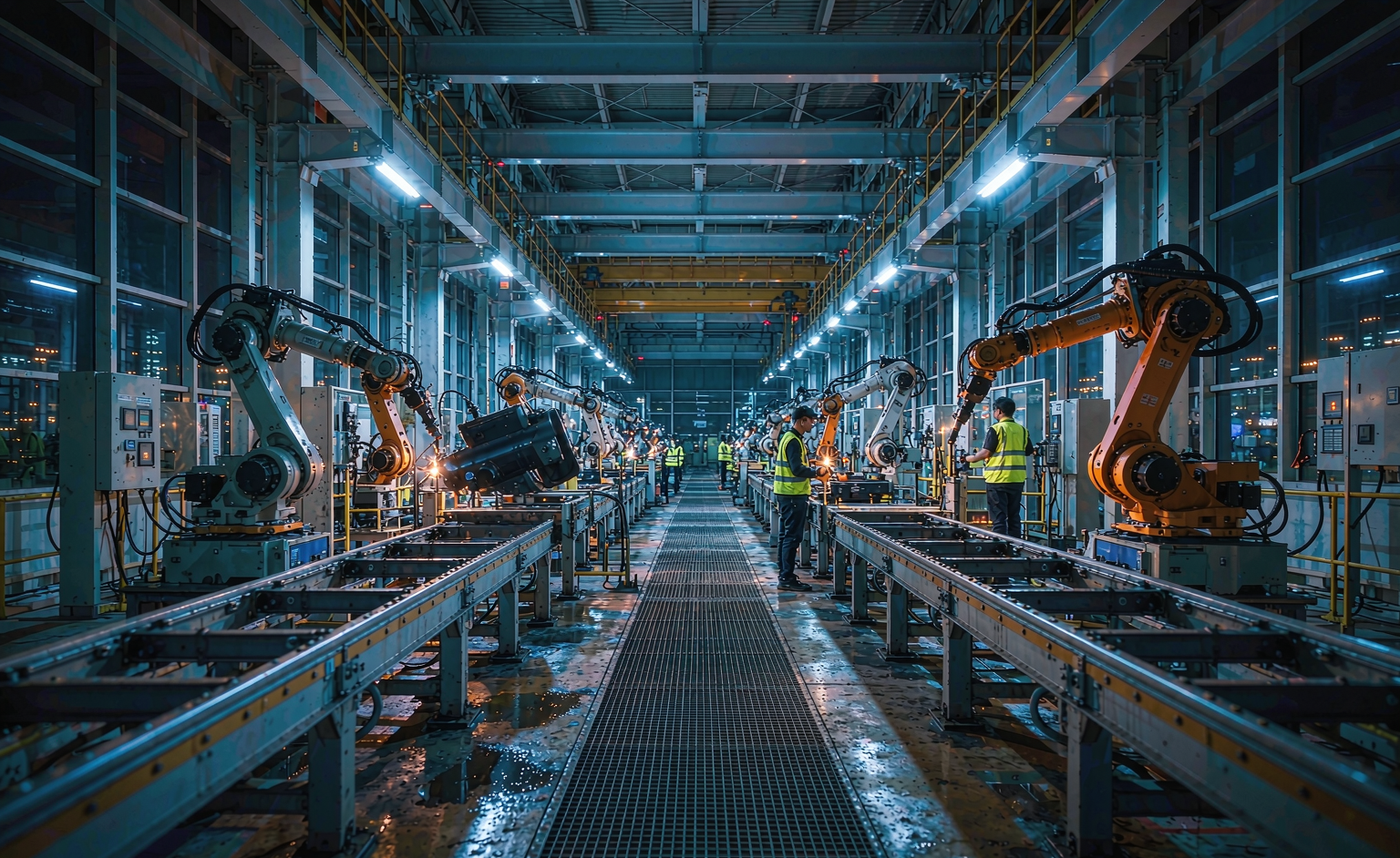
The first batch contained 15 factories. This second list adds 34, bringing the national total to 49. The selected plants cover all regions, from the north-east and north-west to the south-west and centre, and span equipment manufacturing, steel, non-ferrous metals, electronics and consumer goods. Pharmaceutical and garment makers have been included for the first time, using AI to read consumer demand and raise production quality.
AI moves into core operations
Lighthouse factories are expected to validate frontier technologies, explore future production models and lift entire industries. According to the China Academy of Information and Communications Technology, AI applications now account for more than 70 per cent of scenarios at the second-batch sites. They have developed more than 1,000 industrial agents and process over 300 million tokens a day. Most have entered what the academy calls data governance 2.0.
At Dongfang Turbine in Deyang, Sichuan, a block-based collaborative manufacturing system addresses the difficulty of coordinating customised, high-variety power equipment. In Weifang, Shandong, a precision acoustic-components factory developed its own core equipment for micron-level machining of miniature parts.
A car plant in Chongqing uses an industrial brain to link hundreds of suppliers, with AI visual inspection and digital twins covering the full vehicle-production process. At a Nanjing telecommunications factory, dozens of industrial agents make autonomous decisions on scheduling and equipment maintenance, allowing more than 300 products to run on the same line without changeovers.
ZTE’s Nanjing general manager Zhou Jianfeng said the agents sense line conditions in real time and use information flows to drive physical production, completing work orders, resource allocation and quality checks automatically.
Measuring the payoff
Shengu Group in Shenyang has integrated research, production and service into an AI-enabled closed loop for turbo compressors, cutting development cycles by more than half. A Shanghai shipyard uses full-chain parallel manufacturing for an LNG carrier with more than five million parts. In Baotou, Inner Mongolia, an aluminium producer runs on 35 per cent self-generated wind and solar power and applies AI to core electrolysis processes, cutting both energy cost and emissions.
Across the second batch, overall labour productivity rose 34.4 per cent on average and production efficiency 19.3 per cent. China has now built a four-tier system of smart factories, with more than 60,000 at the basic level, 13,000 at the advanced level and over 700 at the excellence level. Products from excellence-grade factories show an average 45.6 per cent drop in defect rates and a 30.5 per cent cut in development cycles.
The 34 lighthouse factories are also driving nearly 4,000 other companies through digital and intelligent upgrades. For Beijing, factory intelligence is becoming measurable infrastructure, counted in agents and token throughput.
Editor’s note: This is an adapted translation of the original Shenzhen News report. It has been trimmed and restructured for readability for an international business audience. The full original (in Chinese) is at https://www.sznews.com/news/content/2026-11/20/content_32219665.htm.