In recent months, from the Pearl River Delta to the Yangtze River Delta, humanoid production lines have gone live one after another, paced in minutes and planned in tens of thousands a year, and even the line’s own handling and assembly are handed to robots.
Whether humanoids can be mass-built is turning from a hard problem into a solvable engineering problem. But the faster the line runs, the louder the question: once all these units roll off, will anyone actually buy them.
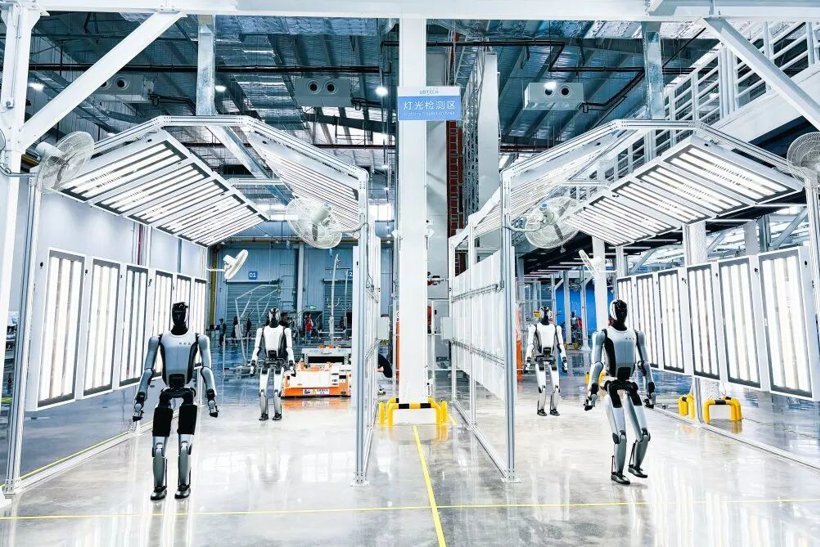
Ten minutes per unit. UBTECH’s Liuzhou industrial humanoid super factory, producing Walker S and Cruzr models, claims one humanoid off the line every ten minutes with planned annual capacity above 10,000, and Cruzr Y1 and S2 units already do destacking, palletising, feeding and handling on the line alongside workers, robots building robots.
Earlier, UBTECH’s southwest line opened in mid-August at semi-automated AGV-plus-manual scale, targeting a few hundred units this year. Days before Liuzhou, XPeng launched its first high-end general humanoid automation line, with a humanoid completing automated final assembly and walking off the line itself.
Stretch the timeline and Unitree, AgiBot, Zhongqing and LeJu all expanded in 2026. Unitree runs Hangzhou and Wuxi plants and plans 75,000 more humanoid units via its IPO. AgiBot has three bases in Lingang, Chengdu and Wuxi with thousands of units a year. Zhongqing runs Shenzhen and Zhengzhou bases, one at a unit every 15 minutes, and LeJu runs a Shenzhen pilot and a Foshan line at a unit every 30 minutes.
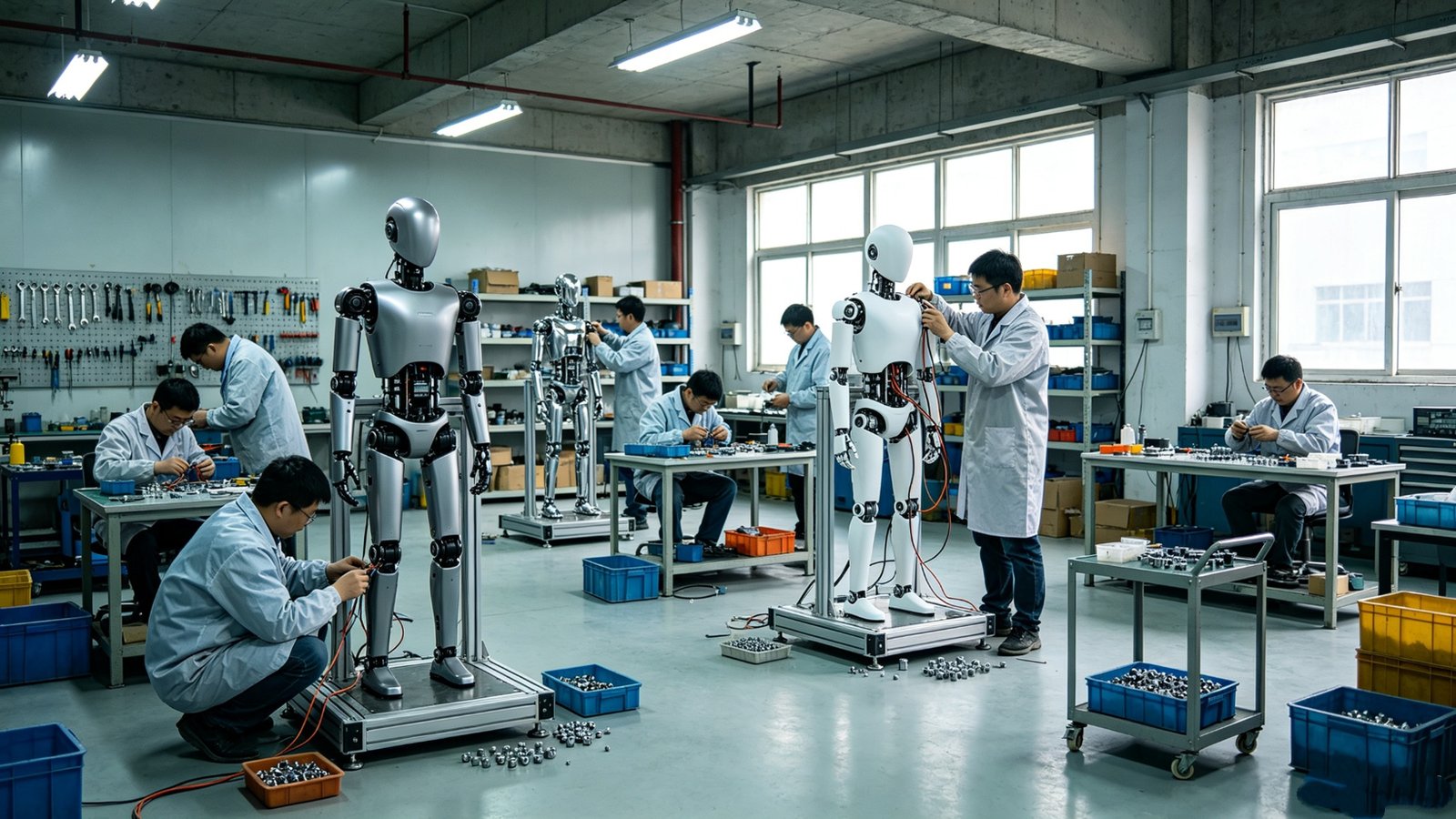
These lines mark a watershed from engineers hand-building in workshops to standardised, replicable flows. Counterpoint Research says global humanoid shipments passed 22,000 units in the first half of 2026, up nearly 300 per cent, with all top five Chinese and an 86 per cent share, AgiBot first at 9,700 units and 43 per cent, Unitree next at about 7,000 and 31 per cent.
By that pace Gasgoo’s Wang Xianbin forecasts about 60,000 units globally this year, 50,000 in China, more than double 2025’s 18,000. But planned capacity and real sales diverge; the MIIT signalled China’s whole-machine output could pass 100,000 this year, yet actual shipments are seen at tens of thousands.
Wang notes the leaders still ship only about 10,000 or a few thousand each, and Unitree’s Xie Yipeng says about 70 per cent of its products went to corporate labs, universities and institutes. Application shares were 15 to 20 per cent in 3C, auto and logistics, but 35 per cent entertainment, 20 per cent data collection and 10 per cent research, so the buyers paying real money are still mostly labs, shows and pilots.
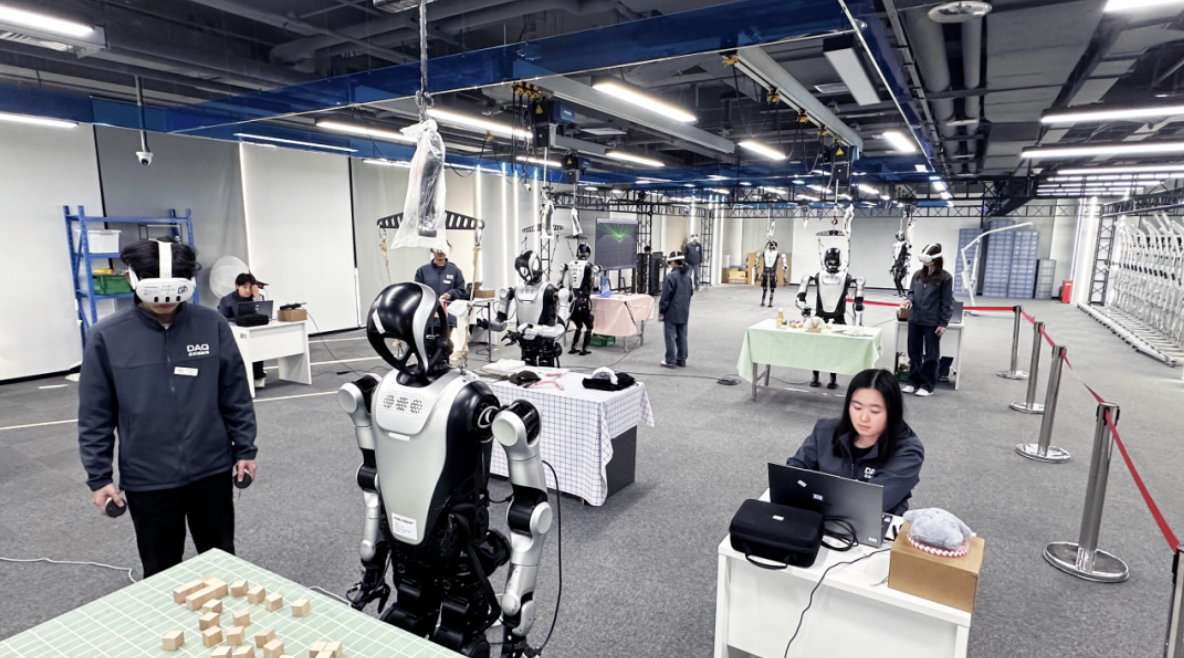
A telling case is Beijing’s Shijingshan humanoid data-training centre, opened in March 2025, which deployed over 100 robots then abruptly stopped in August with partner Realman pulling out. Some founders allege data-centre and related-party transactions prop up unsustainable revenue for listings, and the China Academy of Information and Communications Technology counts over 70 training centres built and 46 more planned by June 2026.
On the demand side, few whole-machine makers profit; a robot costing six figures against the hours it replaces makes payback long. The NDRC’s Li Chao warned again that robotics must develop healthily and in order, guarding against blind herding, after flagging in November 2025 that over 150 humanoid firms existed, half startups or cross-over entrants, and warning against copycat products.

The deeper bind is a broken data loop. Experts at a recent seminar said the bottleneck is not one link but all of them: data volume is the top constraint, then folding touch and force into the decision layer, while the body’s route is unsettled and power budgets are tight, with most chips at 5 to 20 watts against vehicle-level compute needs.
So the numbers that matter are not how many rolled off the line but how many keep running on the job: capacity utilisation, continuous-run yield, repeat-order share and gross margin. When the industry measures heat by units shipped, the cooler ruler is how many of those units are truly, steadily, at work.
Editor’s note: This is an adapted translation of the original Gasgoo report. It has been trimmed and restructured for readability for an international business audience. The full original (in Chinese) is at https://www.gasgoo.com/apps/50640d4b55d5cba175fb84f15d679f19/robot/news/70472761-%E4%BA%BA%E5%BD%A2%E6%9C%BA%E5%99%A8%E4%BA%BA%E5%91%8A%E5%88%AB-%E6%89%8B%E6%90%93-%E7%84%B6%E5%90%8E%E5%91%A2/.