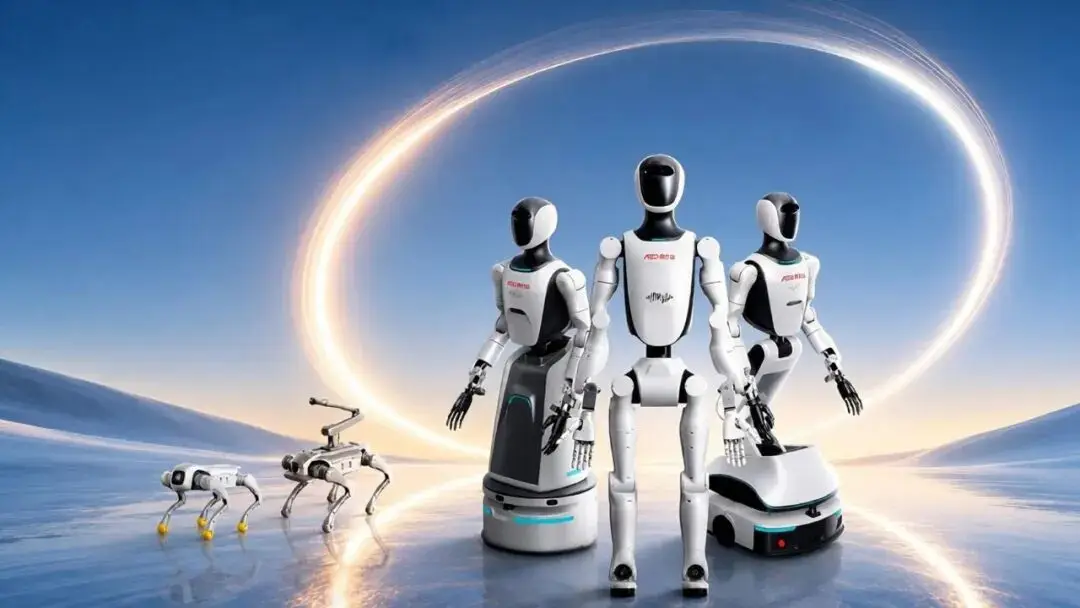
Aishida, a cookware maker listed in Shenzhen since 2010, took half of its stand at the 26th China International Industry Fair in Shanghai on 12 October for humanoid robots. In previous years it showed industrial robots. Alongside the display, the numbers are getting worse.
Revenue in the first half of 2026 was RMB 1.351 billion, up 6.38 per cent. The non-GAAP net loss was RMB 104 million, against RMB 8.225 million in the same period of 2025. That makes six and a half consecutive years of non-GAAP losses since 2020, with cumulative losses approaching RMB 1.2 billion.
The cookware core is shrinking where it counts
More than 70 per cent of revenue still comes from cookware: RMB 1.008 billion in the first half, or 74.62 per cent of the main business. The product family runs from woks and frying pans to pressure cookers, with woks the core item.
Cookware revenue fell from RMB 2.711 billion in 2021 to RMB 1.887 billion in 2025. Unlike most peers, Aishida sells at home and abroad, and the overseas decline is the bigger story. Overseas revenue was RMB 1.8 billion in 2021 and RMB 1.095 billion in 2025, a drop of more than RMB 700 million, hit first by destocking and then by trade friction.
The company’s response has been to spend on promotion, especially domestic online channels, e-commerce platforms, livestream selling and advertising. Total selling expenses reached RMB 544 million in 2025, up 11.4 per cent, higher than in 2021 when revenue was RMB 3.508 billion rather than RMB 2.676 billion. Sales service fees, mainly commissions and traffic payments to influencers, rose 42 per cent to RMB 100 million, and advertising rose 15 per cent to RMB 94 million.
In the first half of 2026 the sales service fee reached RMB 62.6 million, up 84.8 per cent, and selling expenses reached RMB 292 million, up 25.86 per cent. Domestic revenue rose above RMB 906 million, up more than 20 per cent, which offset the overseas decline and produced the small headline increase. Because spending grew faster than revenue, the loss widened.
Robotics grew at a quarter of the market rate
The robot business is run through Zhejiang Qianjiang Robot, of which Aishida bought 51 per cent in 2016 and now holds 97 per cent. Qianjiang builds industrial robot bodies across three configurations from 3kg to 800kg payload, with controllers, servos, reducers, software and machine vision all developed in house, sold into auto and motorcycle parts, new energy, consumer electronics and hardware.
Revenue in the segment went from RMB 278 million in 2020 to RMB 310 million in 2025, a compound annual growth rate of 2.25 per cent. Over the same period national industrial robot output rose from 218,000 units to 773,000 units, a compound rate near 28 per cent. The market grew and Aishida did not.
Competition explains part of it. Industrial robotics has become winner takes most, with Estun, Inovance, Fanuc and Kuka using scale and brand to hold position.
Humanoids are the second attempt. The company began internal work in 2024 and has since launched four humanoid models aimed at commercial, entertainment and family scenarios. It is entering a field already occupied by UBTech, Unitree and AgiBot, each with far greater scale and cash for iteration.
The contract manufacturing answer
Rather than compete only with its own machine, Aishida also builds for others. It has an agreement with AgiBot to provide OEM and ODM manufacturing. Whether that produces durable revenue depends on AgiBot’s unit sales and on how much margin is left to the contract manufacturer.
The balance sheet behind it
Six and a half years of losses have eaten into equity. Net assets attributable to shareholders are down to RMB 1.31 billion, and the debt-to-asset ratio has risen from 58.81 per cent to 71.79 per cent. As of 30 June 2026 interest-bearing debt exceeded RMB 1.6 billion against RMB 386 million of cash on hand, far short of covering it. The company keeps rolling loans: in 2025 it received RMB 1.761 billion of borrowings and repaid RMB 1.76 billion. Interest expense alone was RMB 66.3 million in 2025, a material part of the loss.
The share price tells the same story. It traded below RMB 5 in February 2024, rallied above RMB 24 in December 2024 during the market-wide move and the robot-themed speculation, and has fallen since as losses persisted. The controlling Chen family, which holds 55.53 per cent directly and indirectly, saw its stake value peak above RMB 4.5 billion and stand at RMB 2.1 billion on 21 October, a decline of RMB 2.4 billion. At the high, a holding vehicle controlled by chairman Chen Helin sold 2.21 million shares at RMB 13.14, realising more than RMB 29 million.
The company’s own logic is that a second growth curve is needed and embodied intelligence is the closest one. The order book will decide whether that is a strategy or a description of the problem.
Editor’s note: This is an adapted translation of the original OFweek report. It has been trimmed and restructured for readability for an international business audience. The full original (in Chinese) is at https://robot.ofweek.com/2026-10/ART-898890-12003-30708584.html.