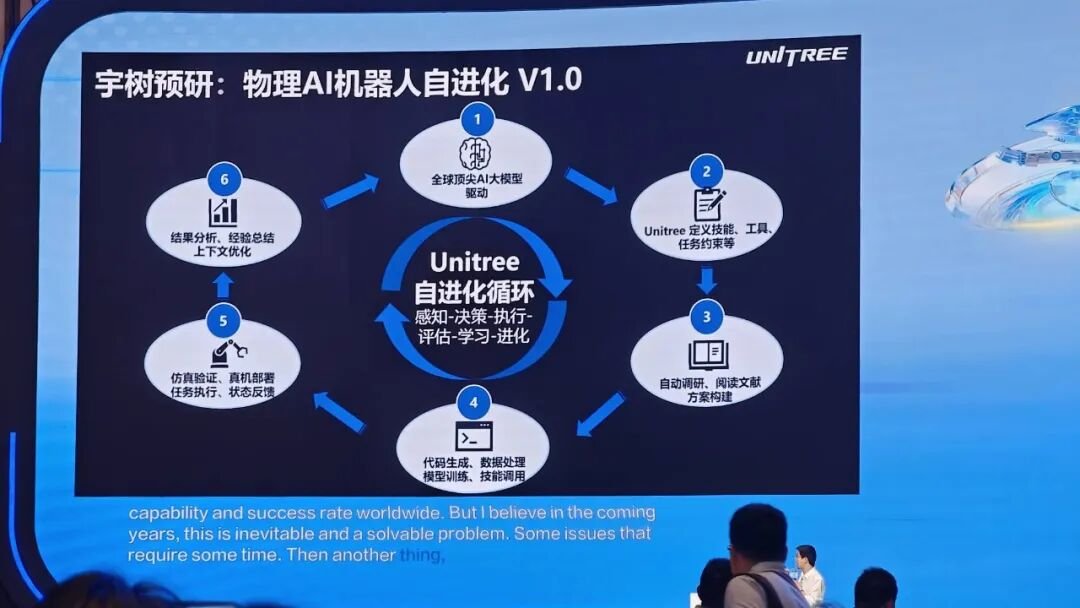
On 19 August, Unitree listed on the STAR Market. At the post-listing dinner, founder Wang Xingxing first proposed the self-evolution of physical-AI robots, using foundation models to close the loop of paper search, code generation, simulation training, real-machine testing and evaluation feedback, moving robot R&D from heavy human dependence toward continuous self-iteration.

A day later, on the main forum of the 2026 World Robot Conference, Wang returned to the theme. Rather than showing how fast or high robots run and jump, he spent his time on a less flashy but more decisive question: when will robots truly enter factories and homes.
In his view the key is no longer whether a body can perform one action, but generalisation. Change the room, the object, the task, can it still complete the job.
Two 80 per cent thresholds
He gave a quantitative tipping point for the industry’s big breakout: two 80 per cents. In 80 per cent of unfamiliar scenarios, through voice or text commands, the robot can complete roughly 80 per cent of tasks. And a clear path: physical-AI self-evolution. Rather than have human engineers tune the robot’s last centimetre, hand the R&D, simulation and testing loop to AI.
The past year brought hardware and motion breakthroughs, from a kung fu routine at the Spring Festival gala to a 50-robot show at the Temple of Heaven. But the company has pushed a more important shift: getting robots into life and factories. From 2024 it worked with car factories on line applications, and most of its AI team now builds for home or factory work.
The blocker to scale is efficiency and generality still falling short. Robots do simple assembly but slower than people, and every new task needs retraining, so deployment stays slow.
In April it hit a peak speed of about 10 metres per second, 36 km/h, in a 100-metre test, a world record for humanoid running. That robot was modified from the first-generation H1, and wheels can be added for flexibility.
Data is the bottleneck
Robots are AI-driven, and AI is data-driven. Unitree collects its own data and partners with third parties. Real-machine data and massive human or internet data are the two must-have pre-training sets.
In May it released what it calls the world’s first mass-production-grade manned exoskeleton, about 3 metres tall, roughly 500 kg loaded, like an off-road vehicle, transformable into a four-legged mode for stability and obstacle crossing.

Wang argues self-evolution is the most worthwhile global project for the next few years. It bends the cost curve of deployment and lets robots improve between jobs instead of starting over.
More from the original report

Editor’s note: This is an adapted translation of the original LeiFengWang report. It has been trimmed and restructured for readability for an international business audience.
Translated and adapted from LeiFengWang (https://www.leiphone.com/category/robot/qtdF8IhMqe2oNmH0.html).