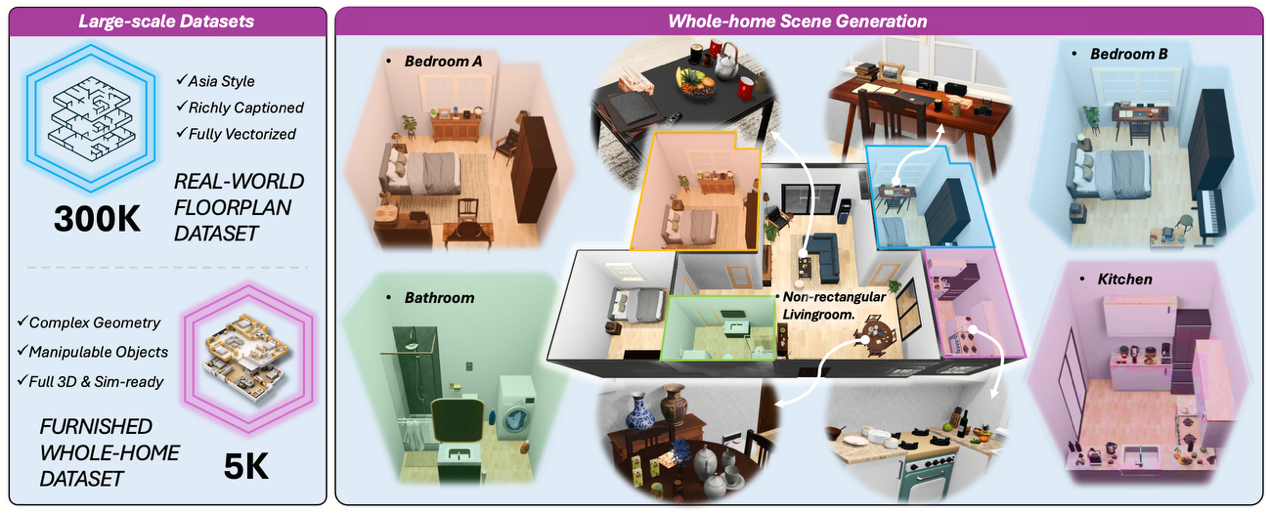
On 5 June, Daxiao Robotics, together with the Chinese University of Hong Kong’s multimedia lab and Shenzhen’s Hetao institute, released Kairos-HomeWorld, described as the first world-model framework that generates a complete home and lets individual objects be fully interacted with. To back it, the team open-sourced the largest 3D dataset built specifically for Chinese households.
Why Chinese homes needed their own dataset
Embodied intelligence ultimately has to enter homes, but home environments are complex and personal, demanding training across hugely varied real scenarios. The new dataset holds 300,000 structured real floor plans, 5,000 complete home simulation scenes and 50,000 physically simulated interactive object assets, filling a gap in large-scale, high-fidelity, locally faithful indoor data. Previously dominant open datasets were built on European and American habits, with open kitchens and no balconies, so robots trained on them underperform in Chinese homes.
Kairos-HomeWorld covers typical layouts from 30-square-metre flats to homes above 200 square metres, restoring China-specific features such as north-south transparency, closed kitchens, separate balconies and wet-dry bathrooms, even irregular old-build kitchens. It is being opened to academia and industry to lower the localisation barrier for service robots.
From text to a trainable home
The model uses a four-stage architecture, from a K-D-tree structured floor plan, to top-view initialisation with first-person detail, to closed-loop validation that fixes physics errors like a sofa blocking a door, to surface-centric object placement. Each scene carries on average more than 15 interactive objects, with a footprint-object density of 4.16. Robots trained in the environment can navigate across rooms and perform long-horizon chores, sharply shortening the sim-to-real transfer cycle.
The global parallel is striking: Figure AI partnered with Brookfield’s 100,000-plus housing units for the same training goal. Daxiao’s edge is cost and speed, generating diverse Chinese-home scenarios with near-zero marginal cost instead of paying for real-estate access and furniture wear.
Read the original report (OFweek Robotics)
Translated and adapted from OFweek Robotics (robot.ofweek.com).