World models have a physics problem. Simulators built on game engines and hand-written rules generate data that never quite matches real-world dynamics. Models trained on video predict beautiful frames but drift on physical and geometric consistency over long horizons. Models that predict in abstract latent space save compute but cannot be evaluated cleanly. The fourth approach, jointly modelling world state and action, asks the only question that matters for a robot: what happens physically after I move.
X-Era AI, a Chinese embodied intelligence startup, has open-sourced E0.5, a native 4D world-action model that treats 3D geometry as the backbone of action learning rather than an optional perception add-on. The paper, project page and code are public.
The architecture choice
Conventional vision-language-action models generate action sequences from visual observation, language instruction and robot state. They inherit large-scale pretraining knowledge but their training objective is action prediction. They learn how to grasp an object without explicitly modelling how the grasp changes the spatial relationships around it.
World-action models extend that to predicting future environment states. Most current work builds them on video backbones, so the prediction target mixes spatial structure with texture and lighting. Depth and point clouds, when used at all, are auxiliary features.
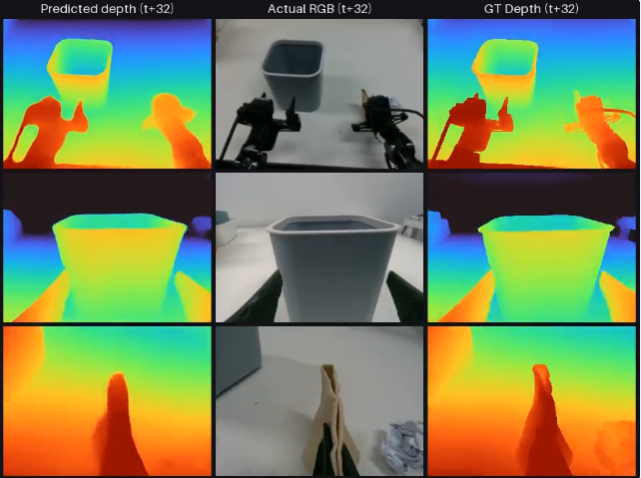
E0.5 inverts this. A 3D foundation model becomes the native backbone, with language-conditioned geometric representations and layer-by-layer geometry-to-action interaction. The model learns action sequences jointly with the future 3D state at the endpoint of each sequence, predicting depth, spatial structure and camera parameters after the action completes. Prediction of future geometry then supervises the trainable 3D backbone directly, so spatial knowledge enters the representation that action generation depends on.
At inference the model does not need to render a future video or reconstruct a future scene. It takes the current observation and the instruction and outputs an action sequence.
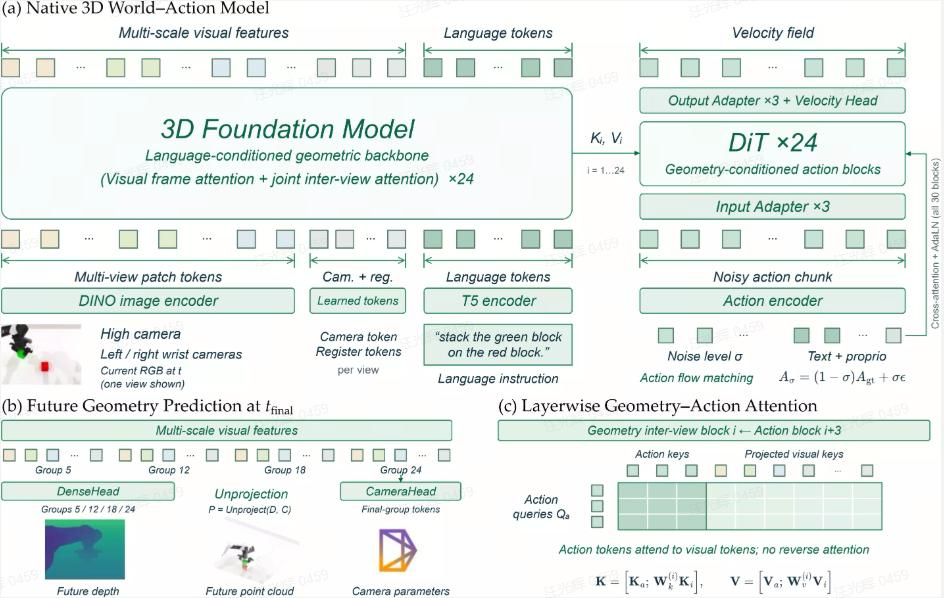
Ablation confirms the design. Under the same training budget, predicting future 3D state instead of only reconstructing current geometry lifts average task success on the RoboTwin 2.0 benchmark by close to 10 percentage points.
Generalisation through geometry, not appearance
The failure mode that kills embodied deployments is distribution shift. A charger sits at a different angle. A cable twists differently. A pile of clutter contains objects the model has never seen. Models that look stable on curated samples lose the whole manipulation logic once appearance and pose leave the training distribution.
E0.5 transfers geometry instead of images. It learns the spatial relationships and interaction rules between rigid objects, flexible cables and containers, not a mapping from a photograph to a script.
On a Zerith H1 humanoid, after robot-data pretraining and task fine-tuning, E0.5 reached 76.7 per cent average success on out-of-distribution tasks against 46.7 per cent for pi-0.5, a 30.0 percentage point gap. The test set deliberately used objects, poses and quantities absent from training.
Long-horizon tasks and the closed loop
Single grasps are easy. Real work is a chain of grasps, transfers and placements, where one skewed placement changes occlusion and available drop space for every step after it. Stitching together demonstration sequences produces a robot that executes a fixed number of steps without knowing whether the task is done.
E0.5 binds each action segment to an expected post-execution 3D state, giving the task chain a series of checkable spatial sub-goals. The model compares observed state against predicted future geometry and decides whether to continue, rather than running a fixed script.
The real-machine scorecard
E0.5 was further pretrained on more than 160,000 real robot trajectories. Across both platforms, average success reached 96.7 per cent on Piper and 100.0 per cent on H1 in-distribution, with combined averages of 85.0 and 88.3 per cent, up 13.3 and 26.7 percentage points on pi-0.5.
Without large-scale robot pretraining, Piper still reached 86.7 per cent and H1 93.3 per cent in-distribution, against 46.7 and 70.0 per cent for pi-0.5. Charger tidy-up, which requires stowing a rigid body together with a flexible cable, rose from 50 to 70 per cent on Piper and 40 to 80 per cent on H1. Garbage cleanup on Piper went from 40 per cent to 100 per cent in-distribution. On H1, with the same 600 demonstrations and five post-training epochs, E0.5 lifted the average from 51.7 to 81.7 per cent.
Four hundred and eighty trials is a small sample by the standards of a benchmark suite, and success rates on three task families in one lab are not a deployment record. But the mechanism is the interesting part. If predicting future geometry is what buys robustness, then the compute spent on video generation has been aimed at the wrong target.
Editor’s note: This is an adapted translation of the original OFweek report. It has been trimmed and restructured for readability for an international business audience. The full original (in Chinese) is at https://robot.ofweek.com/2026-10/ART-8321206-8120-30709495.html.