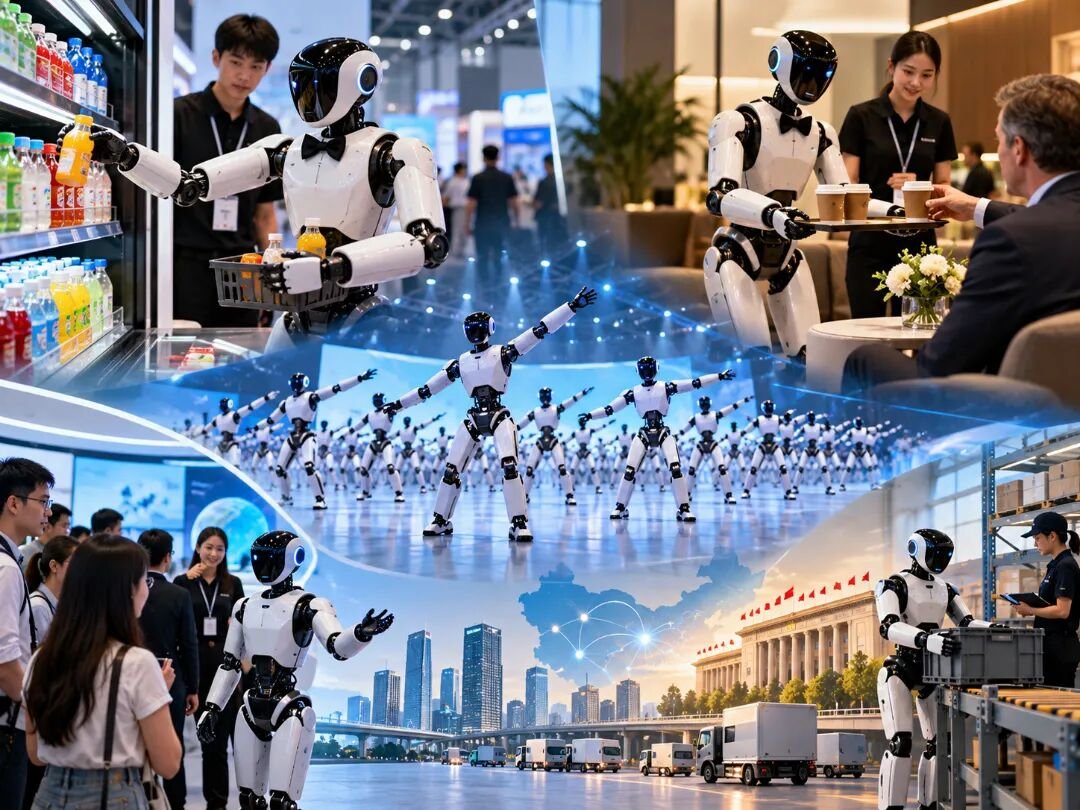
At the 140th Canton Fair, a humanoid wearing a black bow tie took drinks off a retail shelf. Another carried coffee to guests in the VIP lounge. Both came from Guangzhou Zhidong Weilai, the fair’s humanoid service partner, running five scenarios at once. The detail worth noticing is smaller: a staff member stood beside every station. Visitors could watch the robot work and then turn to a person to ask about performance and limits.
Two years ago the standard humanoid debut was a launch event, with preset trajectories, coordinated lighting and failures edited out. This year it stood a continuous shift in a trade fair that has run for seventy editions. It was being examined, not just watched.
Three separate tracks converged on the same word
In January, a Dobot Atom humanoid went into a cinema in Shenzhen. According to company disclosures cited by multiple outlets, it worked 14 hours unsupervised in a single day, sold more than 1,000 tubs of popcorn and took over RMB 20,000 in a day, which the company called a global first for fully autonomous operation in a complex commercial setting.
On 24 October, AgiBot put 110 Expedition A3 units through a simultaneous dance routine in Jinan for a Guinness record. Its senior vice-president Wang Chuang stressed two points: every unit was a production model, not a specially tuned demo, and the formation ran on in-house swarm scheduling with centimetre-level positioning that compensated locally when a single robot dropped offline.
Policy moved the same way. In June the Ministry of Industry and Information Technology and the State-owned Assets Supervision and Administration Commission launched a 2026 action programme for real-scenario humanoid and embodied AI training, covering ten provinces and municipalities plus central state-owned enterprises. The target by the end of 2026 is a set of representative scenarios that have completed application validation and routine deployment, enough to support deployment at the ten-thousand-unit scale. On 19 October nine ministries, including the Ministry of Commerce, issued eighteen measures on technology-driven commerce, naming home services and commercial logistics, and adding tiered governance for commercial AI agents.
The volume is real and so is the structure
IDC’s global humanoid tracking report, published 29 September, put first-half 2026 shipments near 25,000 units, up 432.1 per cent, on a market above USD 740 million. China accounted for more than 19,000 units, about 77.9 per cent of the total, and Chinese manufacturers took over 95 per cent of global shipments.
A second set of numbers describes the stage better. Research and education, performance and display, and government data-collection centres together fell from 83.8 per cent of shipments in 2025 to 69 per cent in the first half of 2026. That is a 15 point shift, not a reversal. Gartner’s January forecast was colder still: by 2028, fewer than 20 companies will have pushed humanoids into actual production deployment in manufacturing and supply chains.
Both statements have to be made together. Growth is close to tenfold and roughly seven in ten robots still do not go to a productive job.
Who gets to test the robot
The bigger change is not whether the robot can work. It is who verifies that it does. Companies used to certify themselves with patent counts, acceptance reports and launch videos, where the vendor issued the evidence, interpreted the standard and kept failures off camera. That is loosening. Cameras are running, competitors are standing nearby, and a failure becomes a short video within hours.
Except that a live audience is not evidence. One company’s disclosures show all three tiers of the problem. Dobot’s 14 hours and thousand tubs come from company statements relayed by media, and the zero-error claim is its own. No third-party continuous-operation report under the same conditions has appeared.
The second tier is unaudited operating metrics. On 14 July the company reported first-half embodied AI shipments above RMB 40 million, more than double its full-year 2025 revenue in that line, with orders in hand above RMB 60 million including RMB 10 million from industrial manufacturing, and noted that the figure included framework letters of intent. Ten days later it announced completed scenario validation and mass production delivery. Shipment value, order backlog and letters of intent are three different things, and in one sentence they read as one.
The third tier is audited revenue. The interim results on 24 August reported revenue of about RMB 316 million, up 106.6 per cent, embodied robot revenue of RMB 45.23 million, up more than twentyfold, or 14.3 per cent of revenue, R&D of RMB 102 million, up 148.4 per cent, and an adjusted net loss of RMB 64.01 million, wider by 179.5 per cent.
To be fair, Dobot lists in Hong Kong, which is why filings, management discussion and traceable numbers exist at all. Most vendors publish only WeChat posts and launch decks, not because they are hiding but because no disclosure channel compels them.
Being seen is not the same as passing
Unitree launched the H2-X on 21 October with a claimed eight-hour endurance, 31 degrees of freedom and a demo of it lifting the front of a car bare-handed. Reports noted the car was a prop and the motion was tuned over repeated takes, with an official advisory to keep two to three metres clear.
The next day, at the 2026 World Physical AI Conference in Hangzhou, the same unit landed badly from a side flip and a lower leg separated at the joint. The footage spread within hours. One machine produced both narratives inside a day. That is not necessarily a product failure. Extreme motions sit at the edge of capability, and a public failure is what real testing looks like.
Wang Xingxing offered a measurable threshold at the same conference: the industry crosses the turning point when a robot, given a natural-language instruction, completes about 80 per cent of the main task in about 80 per cent of unfamiliar scenes. He conceded that the test conditions and task scope have not been defined, so it is a target, not a score. His stated bottleneck is alignment between model output and real motion.
There is one more tension. On 15 October the State Administration for Market Regulation approved the first six national humanoid standards, and Wang was one of the drafters of the technical requirements document. He is being tested and he is helping write the test. Someone has to write the rules first, though it would be cleaner if the writer and the subject were different people.
The only metric that survives
The policy text is more specific about passing than most vendor decks. The action programme requires the user organisation or a commissioned third party to set validation protocols and pass conditions, assessing real task success rate, efficiency gain, safety and economic viability, then issuing a validation report. Those that pass get routine deployment in similar scenarios. It also encourages humanoid-as-a-service and requires a technology upgrade window and an exit channel for fast-changing environments.
The four metrics are the valuable part. Task success rate, efficiency gain, safety and economic viability are what a customer uses to do the arithmetic. Degrees of freedom, torque and endurance are what a vendor chooses to put on stage. The programme’s real purpose is to move the authority to judge from the second list to the first.
If only one standard survives, make it shifts worked. A stage answers whether the robot can do it. A job answers whether it can do it every day. Four lines of record settle it: how many shifts run, where the success rate lands, how long recovery takes, and who takes over when it fails.
Those four lines are the hardest thing to obtain right now. And a sector with only pilot announcements and no exit records cannot produce independent validation at all.
Editor’s note: This is an adapted translation of the original OFweek report. It has been trimmed and restructured for readability for an international business audience. The full original (in Chinese) is at https://robot.ofweek.com/2026-10/ART-8321202-8420-30709612.html.