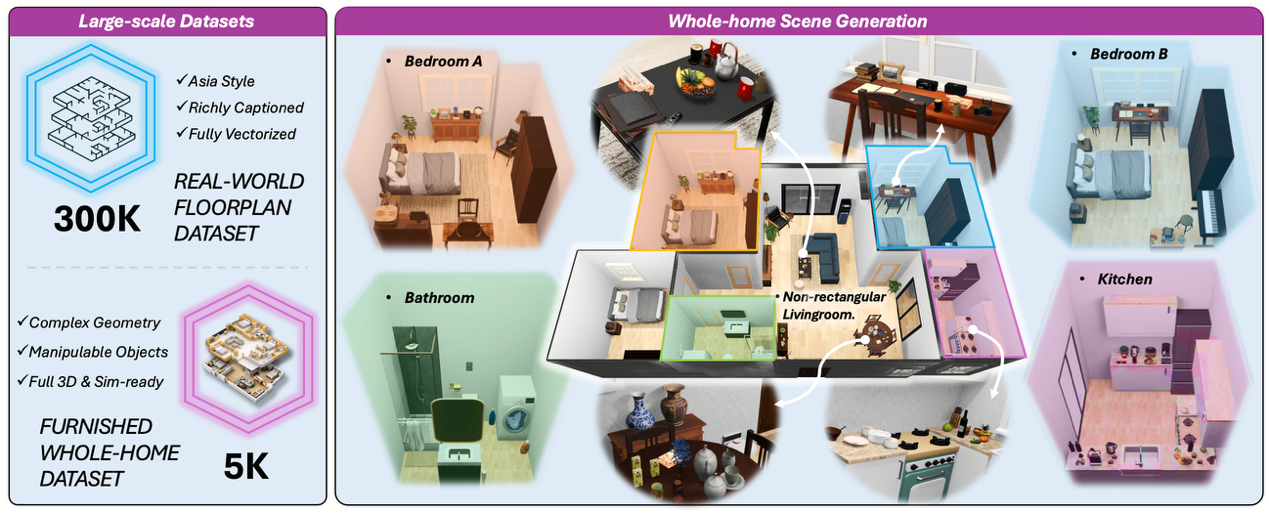
On 5 June, Daxiao Robot, with CUHK’s Multimedia Lab and the Hetao institute, released Kairos-HomeWorld, the first world-model framework to do full-house generation with object-level interaction. It breaks the industry ceiling where indoor generation covered only single rooms with no global consistency or operability, generating coherent, physically sound, fully functional 3D homes from one prompt.
The ultimate goal of embodied AI is the home, but home complexity demands training across massive differentiated real scenes. The team also open-sourced the largest full-house 3D dataset built for Chinese homes: 300,000 real floor plans and 5,000 complete sim scenes with interactive furniture, covering typical Chinese layouts.
Earlier, Figure AI and Brookfield partnered using Brookfield’s 100,000-plus residential units for navigation, interaction and chore training, echoing Kairos-HomeWorld’s logic. But Kairos-HomeWorld is cheaper and faster: generate diverse Chinese-home sims and physics-bearing objects on demand, train robots in virtual space at near-zero marginal cost, free of site upkeep and furniture wear.
Kairos-HomeWorld already trains Daxiao’s embodied daily routines, supporting cross-room navigation and multi-room tidying in full simulation, cutting the sim-to-real gap and lowering the R&D bar for China’s market.
Four-stage generation breaks the ceiling
Kairos-HomeWorld uses a four-stage layered architecture: global structure, local detail, closed-loop check, interaction boost. It generates a full 3D residence end to end from one sentence, reconstructing the indoor-generation paradigm.
Stage one represents floor plans via a K-tree method as hierarchical text LLMs learn efficiently, avoiding room overlap and topology breaks. Stage two uses “top-view init plus first-person detail” to anchor generation on a 3D shell, fixing geometric drift. Stage three fine-tunes a vision-language model for recursive closed-loop checks, auto-detecting and fixing “sofa blocking door” or “object through wall,” keeping collision rate at the industry best.
On object-level interaction, it is the first unified framework for full-house operable objects. Each scene averages over 15 operable objects, with a footprint density of 4.16, all directly importable into a sim engine for grab, move and stack.
The Chinese-home dataset
Daxiao and CUHK released the first full-house 3D dataset for Chinese homes, largest in scale. It holds 300,000 structured real floor plans, 5,000 full sim scenes, and 50,000 physics-ready object assets, filling the gap in large, high-fidelity, locally tuned indoor data.
The 300,000 plans come from real Chinese listings, vectorised and annotated with doors, geometry, zones and connectivity, the largest real floor-plan dataset yet, far beyond the widely used RPLA.
Editor’s note: This is an adapted translation of the original OFweek Robotics report. It has been trimmed and restructured for readability for an international business audience. The full original (in Chinese) is at https://robot.ofweek.com/2026-06/ART-8321203-8220-30689838.html.