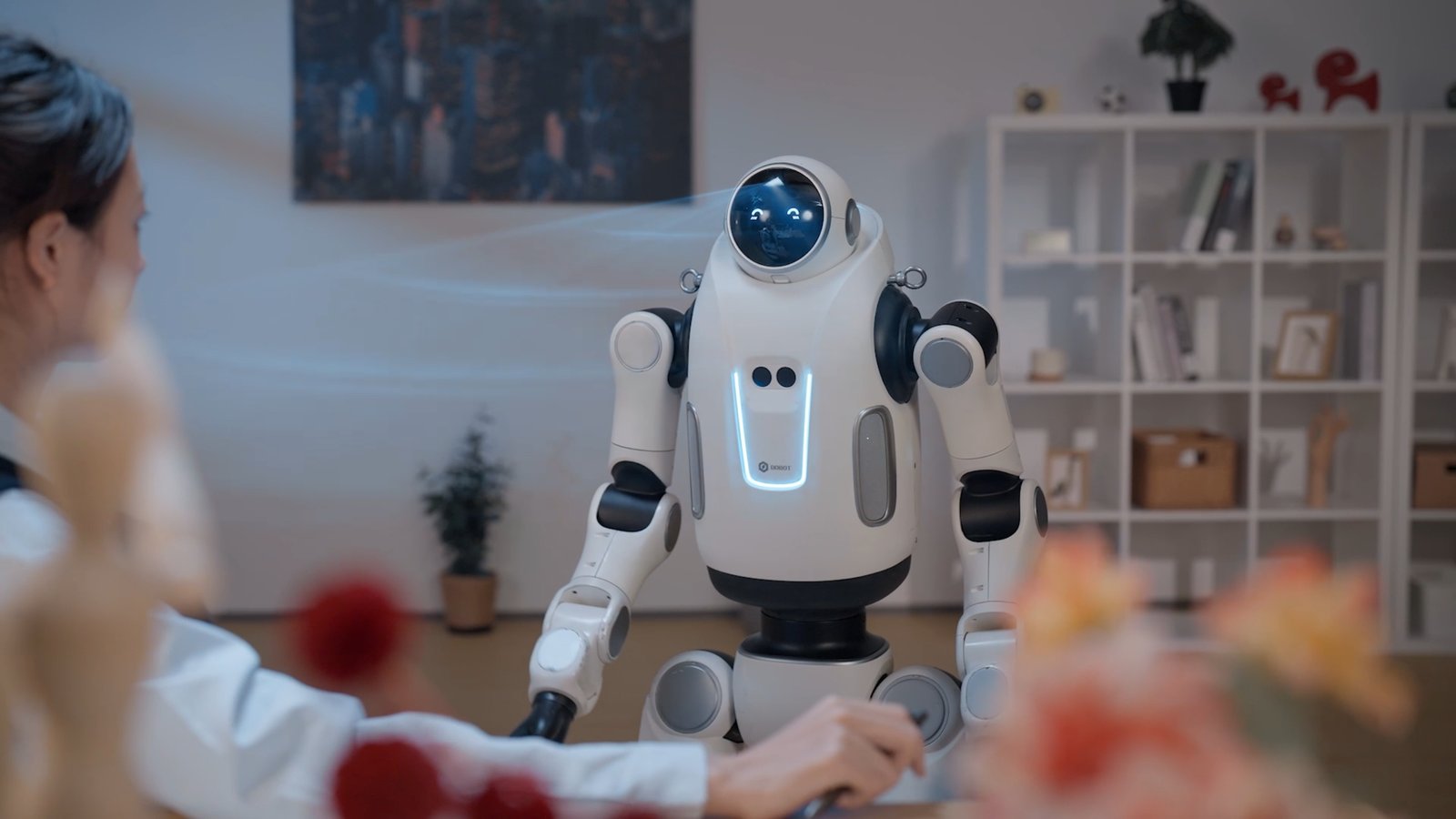
Shenzhen’s Dobot has unveiled Lumeng, a home companion humanoid it describes as the world’s first ’embodied omni’ robot, built to break the old boundaries of space, scene and function that have boxed in consumer robots. The launch on 5 August signals Dobot’s push to turn the humanoid from a voice-command receiver into a character that lives inside homes, schools and public spaces.
Four kinds of freedom
Dobot says ’embodied omni’ rests on four dimensions. Spatial: the robot adapts freely to homes, shopping malls and campuses. Role: it switches identity with the person it meets, becoming a life companion, a sports playmate or a science tutor. Capability: it fuses vision, voice and movement so it moves from passive replies to active perception and action. Lifecycle: it keeps learning from daily use, growing with the user instead of going stale.
That architecture, Dobot argues, is what lets a robot stop sitting in one spot waiting for instructions and start behaving like an agent that fits many environments, many needs and a long relationship.
What is inside
Lumeng runs Kongyi, Dobot’s fully self-developed embodied large model, and claims three advances. First, multimodal emotion perception that reads mood through vision and voice and responds with empathy rather than cold commands. Second, three-dimensional spatial understanding and active movement, with high-precision navigation and obstacle avoidance, a domestically leading humanoid gait and smooth long-distance travel over rough terrain, so it can walk to you and serve you. Third, scenario-based autonomous evolution: it closes a loop on everyday data, remembering family routines, interaction preferences and habits, and gets smarter the longer it is used.
The machine stands about 1.3 metres tall, with softened, friendly styling rather than hard industrial lines. For city workers it offers evening greetings, emotional support and relaxed conversation. For families with children it handles parent-child play, safety supervision and schedule reminders. For teenagers it teaches through physical interaction instead of one-way screen time. In commercial settings it can perform formation dances and rhythm routines.
Beyond the living room
Beyond companionship, Lumeng is pitched at K12 schools, vocational colleges and universities as an embodied-intelligence teaching and development platform, with open interfaces for second-round development across robot fundamentals, motion control, embodied algorithms, SLAM navigation, visual perception and human-robot interaction.
Dobot’s wider claim is that China’s smart-companion market keeps expanding while most products remain stuck at fixed-point voice chat and simple scripted moves, unable to handle multi-environment mobility, emotional interaction or long-term personalisation. Lumeng, the company says, is the generational upgrade that finally brings high-end embodied intelligence into everyday life.
Read the original report (Shenzhen News Network)
Translated and adapted from Shenzhen News Network (sznews.com).