On 22 August at the National Speed Skating Oval in Beijing, the opening of the second World Humanoid Robot Games, cameras cut to a real tennis court. A humanoid stood inside it, and against incoming balls travelling above 50 kilometres an hour it judged the bounce, moved its feet, turned its body and swung, the ball clipping the net tape and landing in.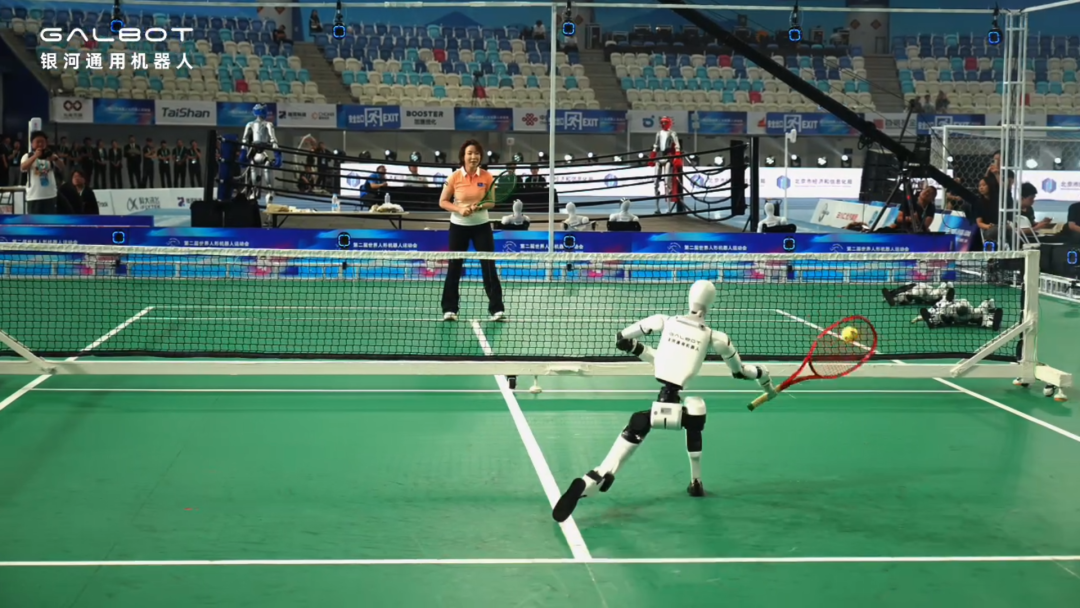
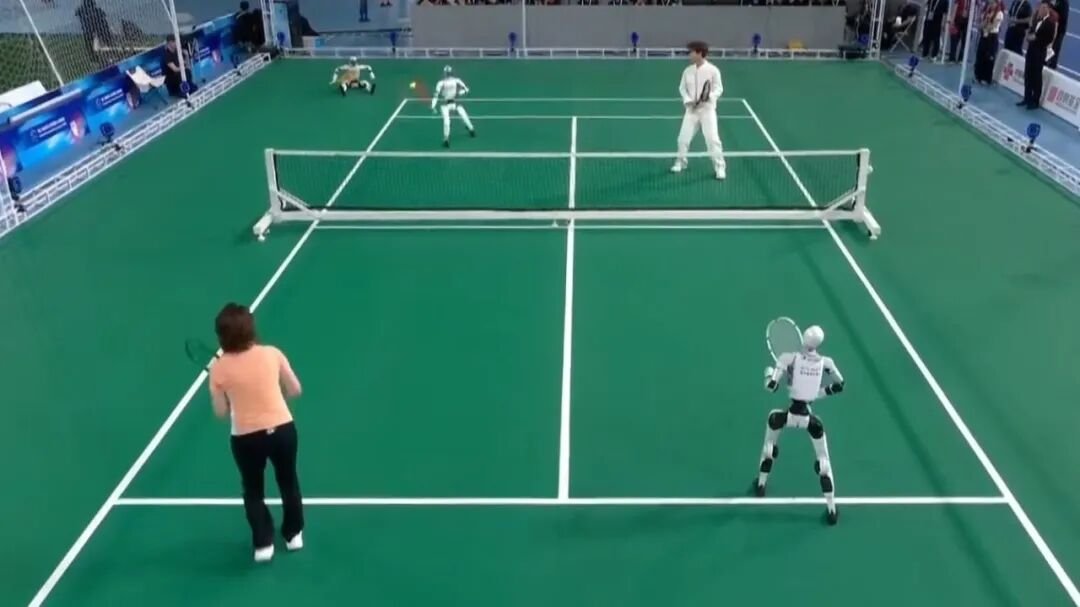
Serve, forehand, backhand, baseline rallies, net volleys, it held up. In a doubles exhibition it covered for a human partner and changed tactics, and after a spectacular diving save it crashed to the floor, pushed itself up off the ground and kept playing.
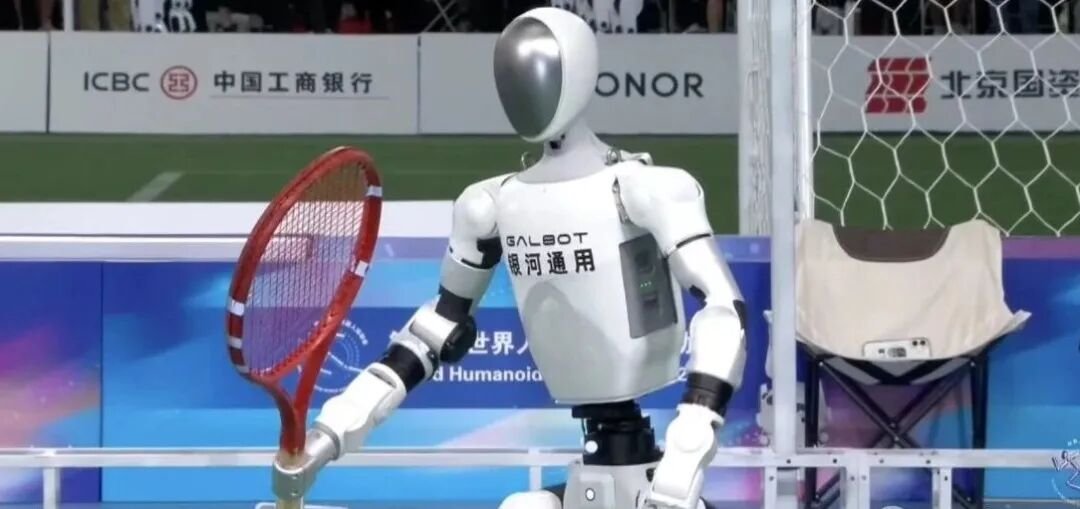
The robot that completed the world’s first fully autonomous tennis rally comes from Galbot, also known as Galaxy General.
Ten years ago AlphaGo proved AI could think. Galbot wants to prove AI can act. The gap between thinking and acting took the field a full decade to close.
The company named the moment AstraTennis. The engine behind it is AstraBrain, an embodied foundation model that welds three jobs into one: the brain for understanding and decisions, the cerebellum for motion control, and the brain-stem that translates decisions into motor commands.
Previously those three lived in separate modules with interfaces that broke under pressure. AstraBrain makes them one system, which the company calls the world’s first whole-body, whole-hand end-to-end model integrating brain, cerebellum and neural control.
To learn under high-speed play it built AstraBrain Latent, the first real-time whole-body control algorithm aimed at tennis rallies, which mines the latent skill from imperfect, incomplete human motion data rather than waiting for perfect demonstrations.
A mechanism called the latent action barrier keeps motions within a human-like style while the robot adjusts its stance and swing to the incoming ball in real time. Training adds random perturbations so the machine learns to self-correct, and by the end it is playing live balls and improvising.
The virtual world behind it rests on Galaxy Star Foundry, a 10-billion-scale embodied dataset. Training runs in two steps: massive rehearsal against virtual opponents of varying skill, then light calibration on the real machine. Multi-agent self-play lets untaught abilities emerge.
Founder and chief technology officer Wang He calls tennis the ultimate exam for a humanoid, because answering it proves you have solved both the cerebellum and the brain. The same capability is already running elsewhere: in smart pharmacies a robot picks target items from tens of thousands, and on factory lines the Galbot S1’s two arms lift 50 kilograms.

Editor’s note: This is an adapted translation of the original LeiPhone report. It has been trimmed and restructured for readability for an international business audience. The full original (in Chinese) is at https://www.leiphone.com/category/ai/DtuJryomWlykalLZ.html.