On 15 September, at the 2026 Embodied Perception Fusion and Multimodal LLM Innovation Seminar, Zhu Jie, vice president of Chaowei Dynamics, shared how to build a data system for general-purpose embodied intelligence.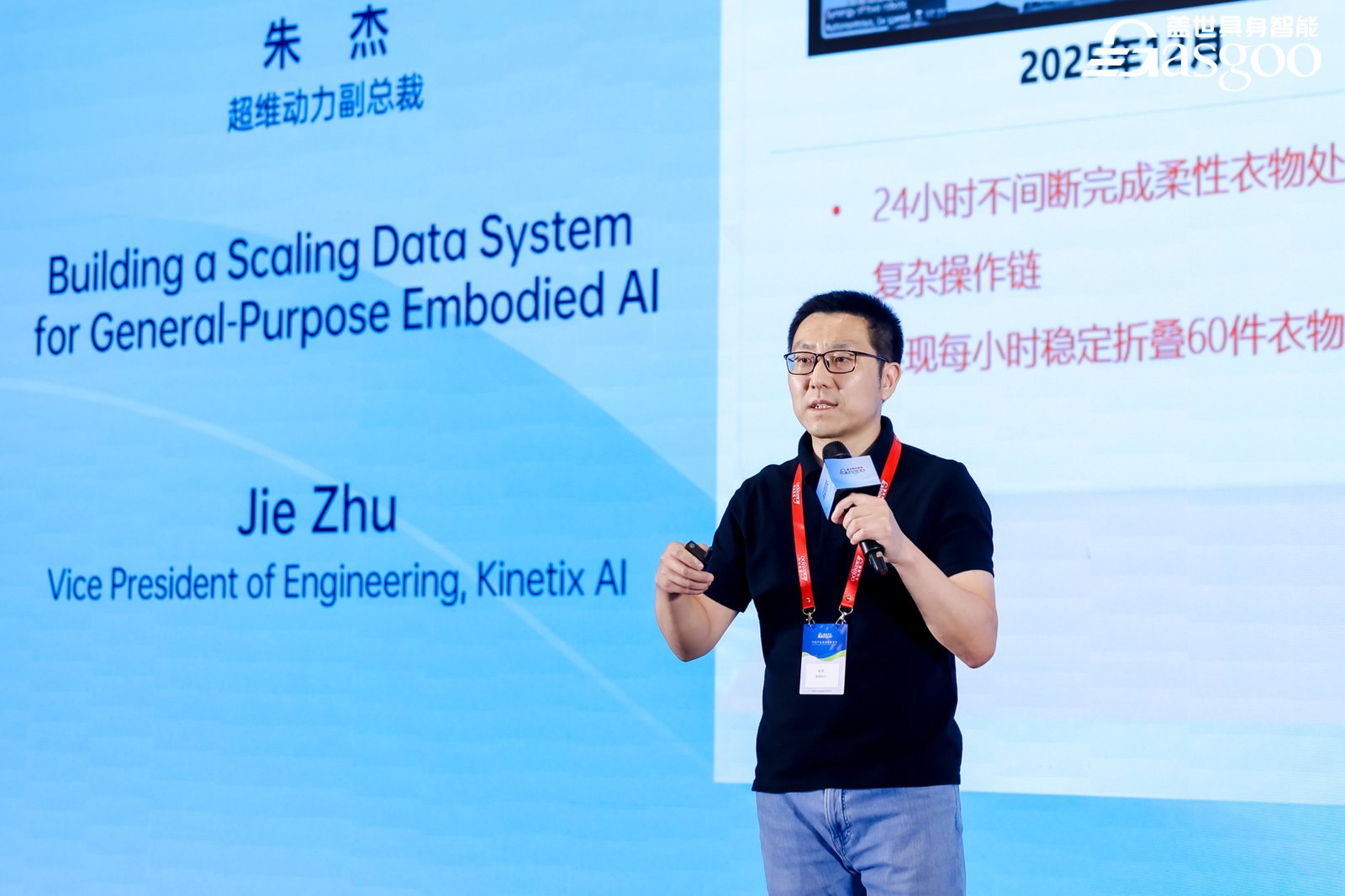
The breakthrough in general embodied intelligence does not rest on a single model architecture. The real infrastructure is a continuously running data system that supplies massive real-scenario data, letting humanoids move from dedicated tools to general agents across industries and homes. The industry must leave the lab’s real-robot collection model behind, and through lightweight capture hardware plus platformised processing build a crowdsourced production system that accelerates the data flywheel of production, processing and training in real scenes.
From fixed scenes to the open world
Chaowei, a full-stack embodied-AI model company, iterated its embodied-brain model over several versions. Early on, in fixed-scene dedicated tasks, it trained on real-robot data and achieved two-arm folding and hanging of clothes with a 24-hour live stream. Moving to a bipedal humanoid with a head active-vision module, it completed ping-pong rallies against a human, a task with three challenges: wildly varying ball paths, millisecond response and whole-body coordination with strict paddle precision.
The need is for massive human-world data across scenarios and tasks. Early collection had long cycles and high cost, about one valid real-robot sample per minute, and dedicated data cannot satisfy multi-scenario demand. Collectors gathering only standard positive samples weaken generalisation; real human activity, with its non-standard motions and trial-and-error, is exactly what trains a robust embodied brain. Chaowei’s EgoHumanoid paper at RSS 2026 showed first-person full-body data markedly improves success in unknown scenarios, a strategy of human-data pretraining plus few-shot real-robot joint training, building a cross-embodiment unified dataset.
Lightweight hardware, heavy cloud
Drawing on first-generation physical-AI autonomous-driving experience, the team built Kai Halo, a first-person capture device of about 300 grams with four cameras and an IMU that solves over 20 body joint points and auto-annotates, breaking free of the lab to crowd-collect across homes, supermarkets, commercial spaces and factory lines. The cloud-side Kai Embodied AI Infra manages all head-rings, dispatches tasks and runs an automated pipeline for quality checks, sensor-anomaly filtering, multimodal temporal alignment and occlusion repair. The dataset is large, diverse and cross-embodiment transferable: human pretraining plus few real-robot fine-tunes adapts quickly to different humanoid bodies.
Annotation, often overlooked, uses an automated multimodal pipeline processing over 10,000 hours of raw data a day, with hundreds of thousands of hours of Ego data already accumulated. Chaowei’s full stack, hardware, algorithm and data, forms a collect-process-train-simulate-deploy flywheel accelerating the evolution of general agents.
Editor’s note: This is an adapted translation of the original Gasgoo report. It has been trimmed and restructured for readability for an international business audience. The full original (in Chinese) is at https://www.gasgoo.com/apps/50640d4b55d5cba175fb84f15d679f19/robot/news/70473480-%E8%B6%85%E7%BB%B4%E5%8A%A8%E5%8A%9B-%E6%9E%84%E5%BB%BA%E9%9D%A2%E5%90%91%E9%80%9A%E7%94%A8%E5%85%B7%E8%BA%AB%E6%99%BA%E8%83%BD%E7%9A%84%E6%95%B0%E6%8D%AE%E7%B3%BB%E7%BB%9F/.