OpenAI’s first AI hardware is perhaps the most mysterious Schrodinger product of the past two years. We still do not know what it looks like, but every few months we get a new answer.
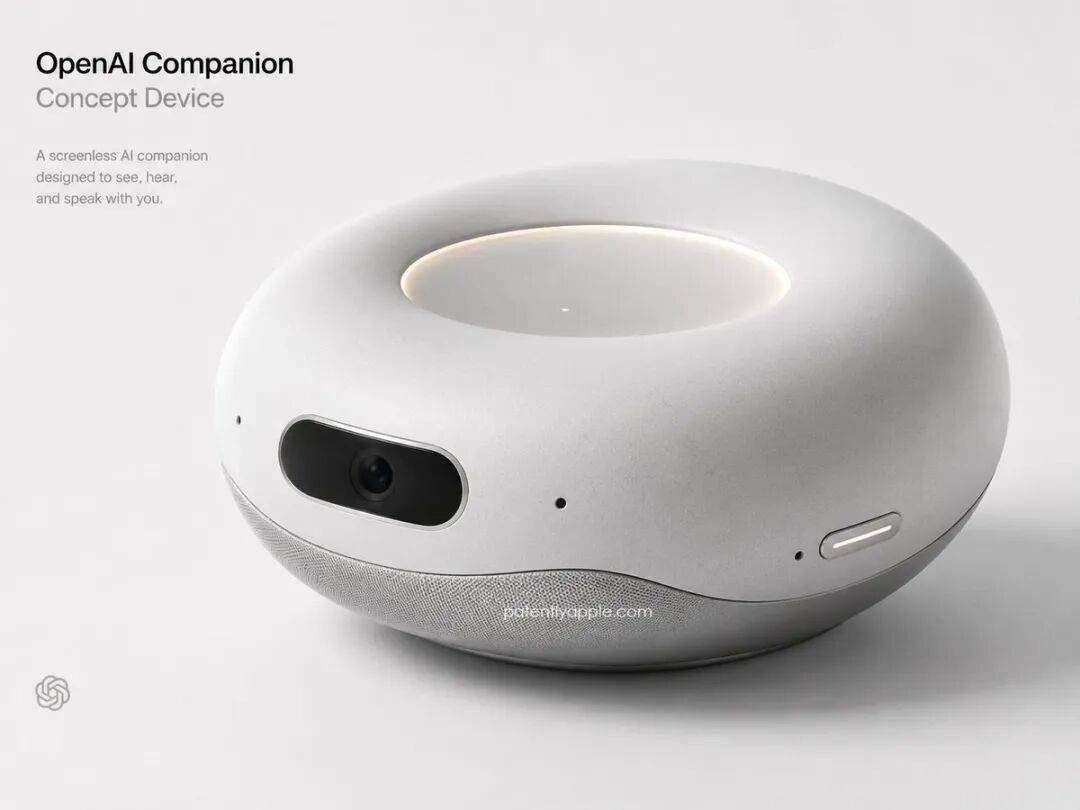
First a smart pen, then a lamp, glasses, wearables. After so many rumours, even spectators developed a boy-who-cried-wolf fatigue. According to Bloomberg today, the first consumer device from OpenAI and Jony Ive’s team is now closer to a screenless smart speaker, shaped like a ring the size of a hockey puck, or more plainly, a metal donut.
At $300 to $400, it could be read as a pricier, finer smart speaker. But OpenAI is more aggressive: it wants an AI-first computer, a device where AI is the primary interaction entry.
The puck-sized disc is only the first shape above water. What OpenAI really wants to test is whether, once AI can carry the main interaction, we still need to stare at a screen every day.
A device that moves
The ring-shaped device is roughly hockey-puck size, picked up in one hand, moved between rooms. No display, but a speaker, microphone, light, camera and other environment sensors, battery-powered, expected next year.
Notably, it is not a static piece of metal. The report says it has internal moving mechanics. As you talk to the AI, parts shift and lights change, so you know it is listening, responding or working. Smart speakers have long been lifeless: you call, it lights; you ask, it answers, then goes silent. OpenAI wants motion, light and more natural voice to give the device presence.
The camera and sensors mean it is not limited to sound. You would not need to tell it there is a pill on the table; you could ask when to take it. You would not describe the kitchen; you could ask if the pot should be taken off the heat.
Vision, voice, long-term memory and environment sensing combined give AI not just a conversation but a continuously present context. That is the direction OpenAI has pushed for years.
Jony Ive after Apple
The design partner is Jony Ive’s LoveFrom. The man who defined the iPhone, iPod, iPad and Apple Watch is now hunting the next thing with OpenAI. Last year OpenAI acquired Ive’s hardware firm io for $6.5 billion, moving from partnership to deep binding, with a long-term plan for a full device business, even a smartphone replacement.
Meanwhile Apple and OpenAI’s relationship has soured fast. Apple has sued OpenAI over trade secrets, alleging it obtained and used information on product design, manufacturing and supply chain, including whether OpenAI asked Apple’s long-time suppliers to develop metal-finishing techniques like Apple’s. OpenAI denies it, arguing it is building something clearly different from Apple’s products.
Apple still tries to put displays everywhere. OpenAI tests a more radical question: if AI is strong enough, does future human-machine interaction still need a screen at all.
Editor’s note: This is an adapted translation of the original Sohu IT report. It has been trimmed and restructured for readability for an international business audience. The full original (in Chinese) is at https://it.sohu.com/a/1059915205_602994.